


We are becoming very used to seeing vacant spaces these days. Empty storefronts on Main Streets or in malls, what used to be a bank branch on the High Street or where ticket offices used to exist before vending machines replaced them.
They are tangible signs of a changing world that is becoming ever more consumed by digital and automated technologies. It’s not a totally new phenomenon, and in some ways, we’re becoming so numb to it that it can feel almost like a civic amnesia for what used to take place there.
Cities like to tell themselves these spaces are neutral, and that vacancy is a pause, rather than a chronic condition. Basically, a technical detail waiting for the market, the plan or the right tenant to arrive and restore things to equilibrium. But spend enough time walking through places that are struggling; economically, socially, psychologically, and you start to feel how untrue that is.
Empty space does something to a city. It drains confidence, interrupts movement and tells people, not all that subtly, and repeatedly, not to linger.
That thought has been sitting with me for a while, going all the way back to my futures work on stations and seeing previously occupied spaces like ticket offices being abandoned, or former retail units long shuttered up. And it’s what made me keen to speak with Evan Snow, co-founder of Zero Empty Spaces.
Evan describes himself as an arts advocate and community builder who happens to have a background in real estate. I like the ordering there, as he isn’t spinning a story about art parachuted into places that need cheering up, nor is it a developer-led exercise in cosmetic placemaking. Zero Empty Spaces emerged from a far more prosaic observation in Fort Lauderdale of there being an abundance of empty commercial space, combined with a shortage of places where artists and creatives could actually work without betting their financial future on a long lease.
The obvious by the playbook response would have been to assemble a coalition, apply for grants and wait for permission. But Evan and his partner didn’t, and instead self-funded something more action oriented. As he puts it, “we didn’t wait for a check to come … if we were going to wait for a check to come in the form of a grant or philanthropic gift, we might still be waiting.”
They went to landlords with a proposition that was less cultural than practical saying ‘give us the space until you find a permanent tenant, we’ll activate it, cover the costs and leave when you’re ready’. They designed the brand, built the walls, handled the insurance and carried the operating risk.
What struck me as Evan talked wasn’t the novelty of the idea, but how little romance it required. Art is involved, yes, but art isn’t the real product here, confidence and behaviour change is. Again and again, the same pattern plays out as a space that’s been empty for years fills with people, footfall returns; energy accumulates, someone walks in, feels it, asks for the landlord’s number and a permanent tenant follows. The street recovers a little muscle memory in the process.
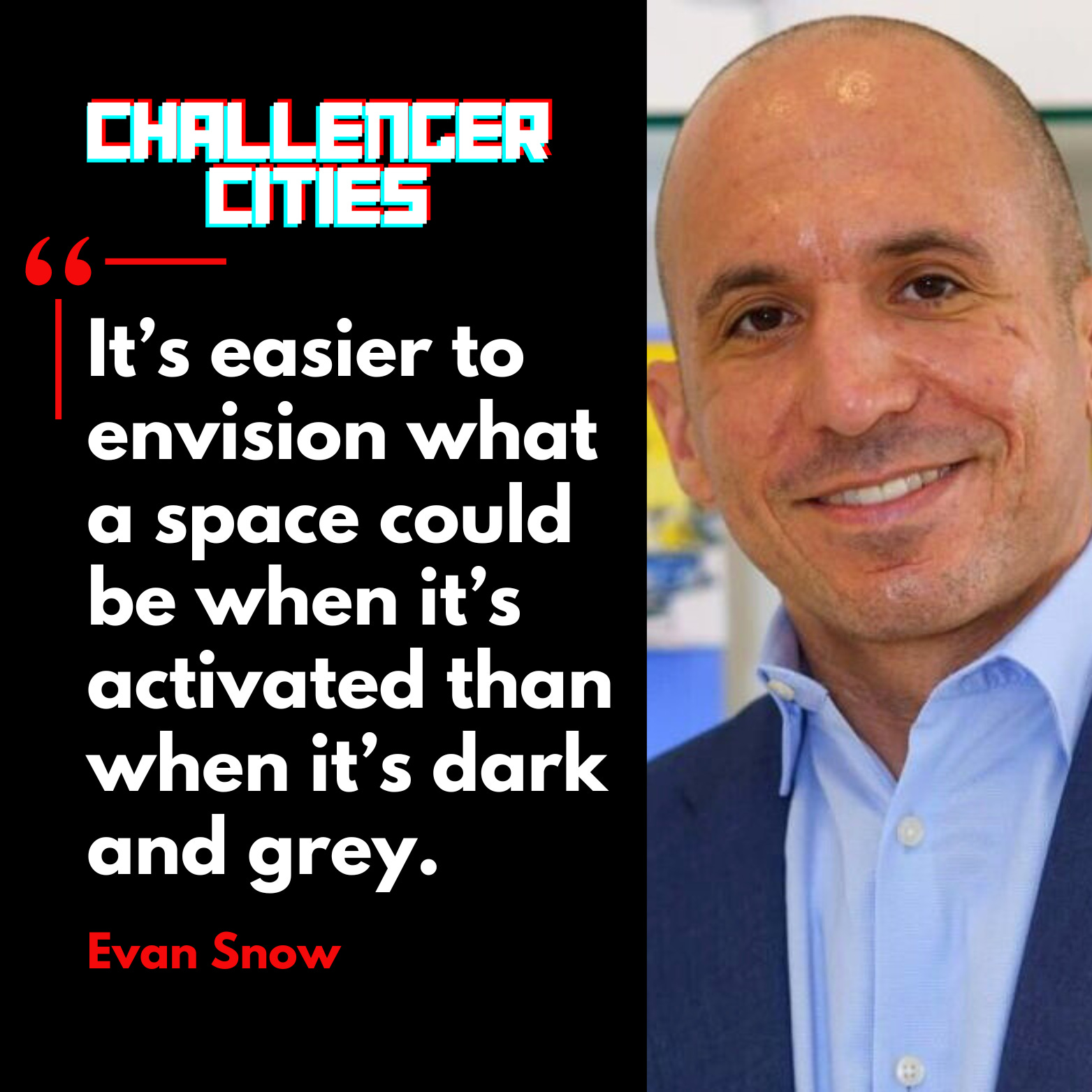
“Activity creates activity,” Evan says, almost in passing. But what he’s really describing is belief that a place can work again once someone shows it how. Cities routinely underestimate how powerful that is. Evan is consistently clear on the value to both the city, and the property owner through what he’s providing as “it’s easier to envision what a space could be when it’s activated than when it’s dark and grey.”
As the conversation unfolded, it became clear that Zero Empty Spaces isn’t just repeating the same trick in different locations. They read the bones of the building too. So former banks become studios arranged around vaults as key features, a retail shell turns into co-retail incubators, and even redundant Burger Kings - half kitchen, half dining room - become commissary kitchens for chefs who aren’t ready, or able, to risk a full blown restaurant.
“Not every empty space is created equally”.
What’s interesting isn’t the cleverness of the reuse so much as the mindset behind it. Rather than forcing a single idea into every space, they let the space suggest what it wants to become. That alone puts them ahead of a great deal of contemporary urban thinking.
At one point, Evan mentions WeWork — almost cautiously, as if aware that invoking it has become unfashionable. But I think it’s a useful comparison if you strip away the excess and the financial overreach. What WeWork understood, at least in its early days, was that people don’t just rent space. They rent possibility, proximity to others and the chance that something good might happen if they put themselves in the right environment.
Zero Empty Spaces borrows that insight without the hyperfinancialisation. It creates places that allow for both closed mode and open mode of making and showing, focus and collision. Cities are full of people stuck permanently in one or the other. They rarely build for both.
Listening to Evan, I kept coming back to something cities used to be much better at, and have discreetly lost. Low-risk ladders are places where you can try something without betting the farm in the form of long term financial commitments, where failure can’t ruin you. They allow for identity to be tested before it has to be formalised into a business plan.
Those ladders didn’t disappear entirely by accident. In some cases, zoning made them illegal, and finance made them unattractive. Planning culture replaced much opportunity for experimentation with certainty and control. Zero Empty Spaces rebuilds them without ever naming them as such.
We can hear it in the stories Evan tells, such as retirees finding reason to leave the house again with a place to showcase their passion, people who’ve been making things privately for decades and suddenly see themselves reflected back as artists whether their medium is sculpture, paint, words, fashion, food or drinks.
I couldn’t help steering the conversation toward transit stations and downtown cores, the places where obsolete space is most visible and least questioned. Think shuttered ticket offices, dead kiosks, redundant offices, bank branches, post offices or former staff rooms. All sealed off, waiting for a future phase that rarely materialises. Evan’s instinct is immediate as “an artist would gladly take that kiosk where thousands of people walk by every day,” knowing they can thrive there.


Feasibility isn’t the blocker here, but culture and complacency is. Too many cities still treat activation as decoration, think murals as apology, rather than as infrastructure. A mural can signal care, it can get people to stop for a picture, but it isn’t enough by itself to create collision or community.
At one point in the conversation, Wynwood in Miami comes up, almost inevitable really. Evan talks about discovering art there, about how it changed the way he saw his city and his relationship to culture. It’s an important origin story, not just for him, but for how many cities now think about murals as a shortcut to vibrancy.
And to be fair, murals give people a reason to slow down, take a photo, look again. Wynwood proved that at scale, but what tends to get lost in the imitation is that the murals are never the whole story. They work because they are embedded in a wider ecosystem of informal places to hang out, be that studios, warehouses, galleries, coffee shops, bars … the third spaces that turned visual interest into social life.
Evan is realistic about this as he says murals can draw attention, but “not every empty space is created equally,” and not every form of activation does the same work. What actually matters is what happens around the art. The ability to step inside somewhere, talk to someone, connect and linger.
It’s why Zero Empty Spaces focuses less on the spectacle and more on the conditions. “We’re not picking the art, we’re creating the conditions,” Evan is keen to reinforce. The murals might get you to look up, but those third spaces are what keep you there.
Cities that stop at murals mistake visibility for vitality, but places that pair them with places to gather, make, sell and experiment turn attention into momentum.
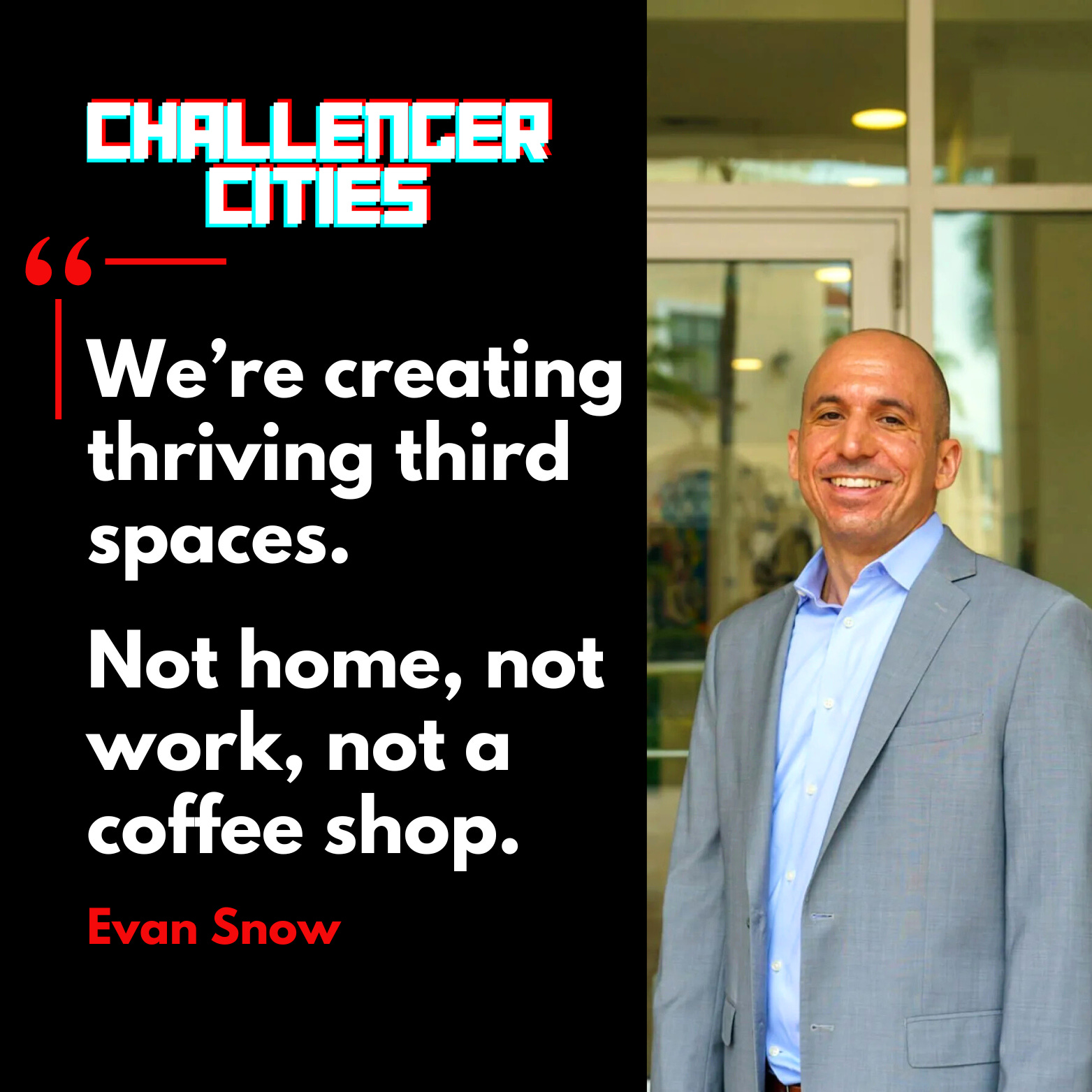
When I ask Evan the closing magic wand question, he’s very practical as there’s no talk of grand cultural programmes or endless public funding. Instead, he talks about defaults, such as if empty space simply had to be activated as the normal thing you do instead of boarding it up. Six weeks, six months, whatever makes sense. Just a clear expectation that vacancy isn’t an acceptable end state.
From there, his thinking gets even more practical. He imagines properties that owners no longer want, or can’t justify holding, being donated into permanent use, turned into dedicated cultural infrastructure rather than speculative assets. A bigger ambition, he admits, is housing, but tailored to creatives. Think live-work spaces that utilise former motels. Artists, don’t need luxury, but they need space, and such assets might be the ideal canvas for them to make their mark on.
Challenger Cities don’t wait for perfect tenants, because they don’t pretend confidence will return on its own. They understand that momentum is fragile, and that sometimes the most radical thing you can do is open the door and let people in rather than letting something sit empty waiting for the perfect tenant to arrive.
Zero Empty Spaces is a reminder that most urban problems aren’t waiting for more intelligence, more data or more funding. They’re waiting for someone willing to make the first move.
It leaves a question hanging that more cities should always be thinking about acting on; if you have empty space and lonely people, what exactly are you waiting for?
To being Challengers.


