


I’ve been thinking for a while about what I’d loosely call permission spaces in cities, i.e. the places that allow people to be versions of themselves that the rest of urban life doesn’t easily make room for. It’s sort of stemmed from that insight that kink culture might actually have a lot to teach innovation and urbanism types in terms of a framework for experimentation and learning.
I can’t seem to let that insight rest, and it cropped back up when I hit this theme of the third spaces that urbanists tend not to talk about. Plus people really seemed to like the conversations about the rise of sauna culture, and the love of the pub.
But what about third spaces for intimacy? That’s how I found Paul Meyers and his business, SPNKD, because there is a bit of a growing market for places where adults can be adults.
Paul is Belgian, based in Antwerp, and about seven years ago he built a space for himself. He was in a relationship, he had kids at home, he was curious about exploring his sexuality more creatively, and he kept running into the same problem … the spaces that existed for people like him felt wrong. Tacky dungeons where you felt like a weirdo or hotel suites that felt too small and expensive. Nothing that felt like somewhere you’d actually want to take a partner.
So he bought a warehouse, and designed what he describes as a boutique hotel crossed with a BDSM dungeon. Warm, consciously considered, private. He built it mostly for himself, overdid it slightly on the budget and thought he’d rent it out when he wasn’t using it and see what happened. They didn’t really advertise, and they’re not on Airbnb.
“It’s like people really had to find us,” he says. “But apparently they did.”
What he didn’t expect was the questions that followed. People found the space and then started asking how to use it, not so much practically, but emotionally. How do we actually talk to each other about this? How do we explore something together without one person feeling like a weirdo or the other feeling unsafe? That gap between having a beautiful space and having the language to inhabit it properly was the inflection point for what SPNKD has become. It’s now a brand, with the original in Antwerp, and a Berlin launch imminent … with events, workshops, coaching and a shop. Paul’s real business, it turns out, is not so much about the rooms, but the support arpound them.
COVID helped, oddly enough. With everything closed across Europe, a private space you could book just for your household was one of the few places couples could actually escape to. Paul used the time to think properly about what he was building. He’d noticed something uncomfortable in the kink world he was spending time in where a lot of people were using extreme sensation to avoid connection rather than deepen it. Think numbness seeking stimulation. He wanted to push back against that, and so his workshops now start from the inside out.
When people came to him asking to be taught techniques like how to spank, or how to tie someone up, he kept starting in the same place. “I always started with: how is your connection with your partner or with your play partner? All those techniques, it’s interesting, but if the underlying layer is not there, then we are missing something.”
One of the things I find most interesting about Paul is how transferable his framework turns out to be. Between us, we made an offhand remark that deserves more than an offhand treatment, that maybe he should run a BDSM-for-the-workplace workshop. In kink, you design the arena before you enter it, so you make explicit the spoken and unspoken rules, establish how power flows, agree on how to signal when something isn’t working, and you build in aftercare. In a way, it’s rather mundane. But that’s probably why it makes the spicier stuff work.
Meanwhile, in most professional environments, you have some warped version of something that passes as “agile”.
I’ve been involved in hundreds of professional projects and I can’t think of many where I could honestly say the communication happened clearly, the boundaries were understood, the check-ins were real rather than performative, and there was a proper moment at the end to decompress and reflect.
Paul has a concept he calls the arena where every context has its own spoken and unspoken rules, and in BDSM you make those explicit before you enter. Then he turns it on the professional world: “If you look at the professional world, what you should do is if you have a team, which is our arena? What are the spoken and unspoken rules here?” The frameworks that exist in most workplaces manage time and tasks, but almost none manage how people actually function together. He let that thought run before landing on: “Maybe I should bring this kind of BDSM for the workflow workshop.”
He also has a sharp observation about contemporary culture and the elaborate permission structures we’ve had to build around doing nothing. If you sit on your sofa and stare at the ceiling for four hours, you’re lazy. If you drive an hour and pay £150 to sit in a Nordic spa, you’re investing in your wellbeing. The content is broadly the same. The frame is completely different, and it’s the frame that makes it socially acceptable. Montreal, where I live, is full of Nordic spas. People will happily drive an hour out of the city and pay handsomely to sit quietly somewhere warm. But sit quietly at home? That’s not doing anything.
SPNKD lives in the same gap. It gives couples a reason, a frame, to take four hours for each other that the culture hasn’t otherwise made easy. Not therapy, because it’s not that bad. Not a night out, because it’s not about performing for others. Just time that is intentional and unhurried. Paul designs for four-hour stays because that’s the natural unit of genuine intimacy, long enough that you need to think about more than the main event. You need somewhere to pause, to make tea, a corner with a blanket. He thinks carefully about all of it.
“Maybe you want to take a break and maybe you want to drink a glass of wine or a tea. But if you want to take a break and drink a tea, then maybe you need a cozy corner where you have like a little kitchen area. If you’re in a regular dungeon where everything is dark and black , where are you going to drink your tea or your glass of wine if you take a break? It’s not fair.”
The cosy corner is a recognition that real intimacy, requires the full arc of human experience, not just the heightened bits. Which is a lesson that urbanism could probably stand to think about more seriously. When was the last time a planning brief used the word intimacy as an outcome? When did we last evaluate a public space by asking whether it created the conditions for it?
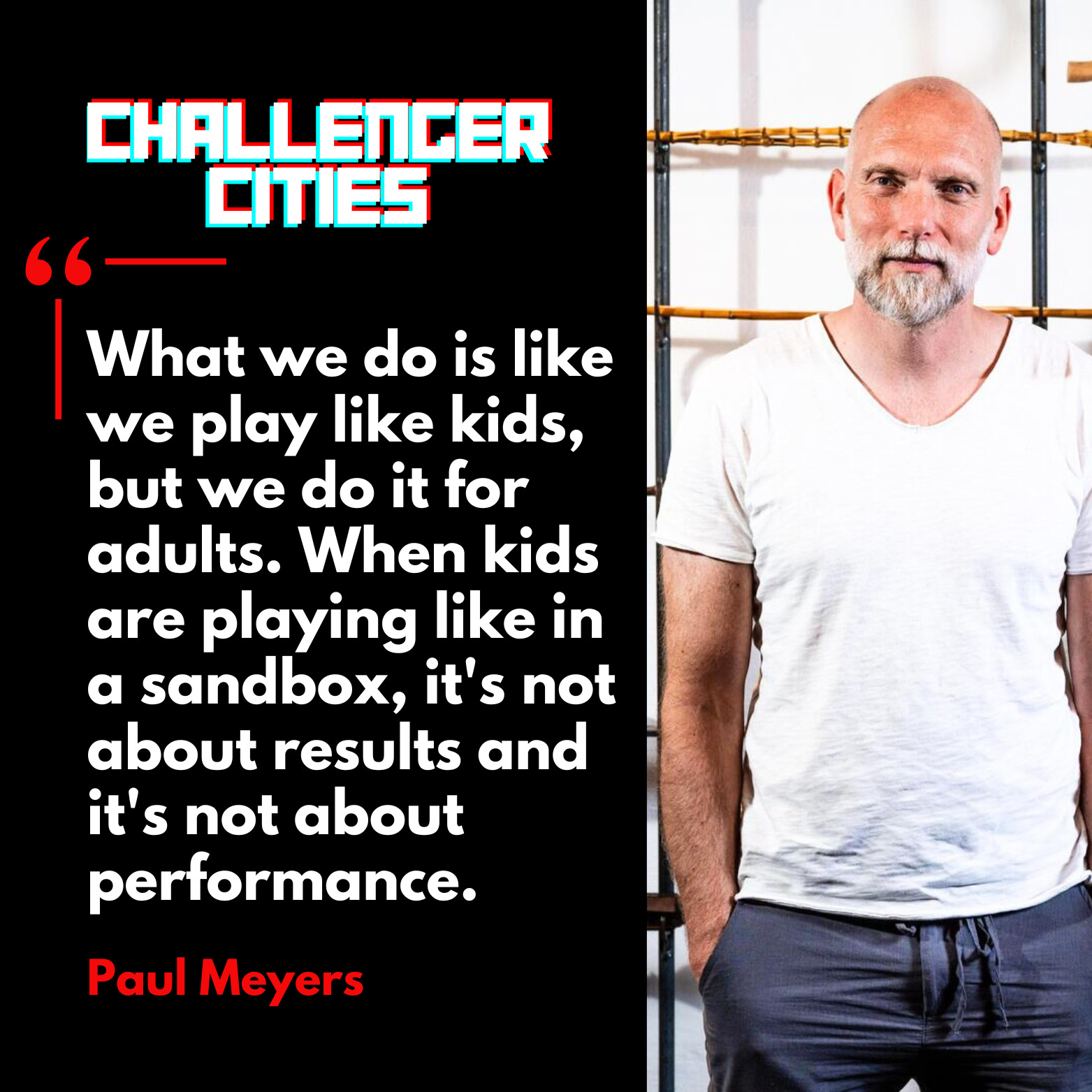
"What we do is like we play like kids, but we do it for adults. When kids are playing like in a sandbox, it's not about results and it's not about performance. It works as long as it works, and in the middle of the play it might change." Most of the things we do as adults that are supposed to be pleasurable … holidays, nights out, anniversary dinners … are loaded with performance and expectation. The notion of the sandbox (ironically something that can apply in tech as it does in play) removes that. You're not there to directly achieve anything, which, if you think about it, is an extraordinarily rare thing to be able to say in most aspects of grown up life.
Paul has a good theory about why so much of the kink and BDSM world has ended up feeling cold and performative. He thinks the visible scene of parties, clubs, events, is heavily shaped by what men tend to optimise for when designing spaces for sexuality; the visual, the theatrical, the mirror-on-the-ceiling. What gets designed out is the feminine sensibility that values atmosphere, comfort, emotional safety, pacing. Berlin’s underground scene, which is significant and genuinely interesting, is cool in the way that Berlin is cool … think raw, open, occasionally jaw-dropping. But it’s not a place most couples go to improve their relationship. There’s almost nothing in between the underground and doing nothing.
That’s the gap SPNKD is expanding into in Berlin. Paul is not pretending it’s the same city as Antwerp. Berlin is more raw, less immediately aligned with the boutique end of what he has done in Belgium. But he’s done the analysis, looked at the community of facilitators, the community and decided there is a gap real enough to be worth filling.
It got me wondering about the cultural differences beyond Belgium and Berlin, and how the concept might apply for North America. He wondered aloud whether the culture is ready, and I’m a bit torn. Anglo cultures are more closed about intimacy than continental European ones, broadly speaking, I say this as a Brit who moved to Canada and still finds both countries culturally a bit buttoned up. But repression isn’t absence of desire. In researching a piece to be released on here soon around “kinky cities”, I looked at FetLife membership as a rough proxy and Toronto, one of the more conservative cities I know, has a surprisingly high density of accounts. So the desire may very well be there, but what could be missing is the middle layer of the guided, welcoming, aesthetically considered space that makes the first step feel more approachable.
Which, when you think about it, is exactly what SPNKD built. And exactly what most cities are terrible at providing.
When I asked Paul what he’d do with a magic wand, I liked that he didn’t jump to something about SPNKD or kink though.
“I hope that we will evolve back to cities, or a world where we can recreate communities, not communities like we had before, but more communities where we have this balance between the masculine and the feminine energy and where we use communities to… what we need as humans, like to regulate our emotions, to share emotions, to create safety for each other, to feel cared for. Because I think we miss that now a lot.”
He was clear he doesn’t want to force this on anyone, for he’s sceptical of anyone who wants to change the world for the better, having seen how that tends to go. But he’s doing his version of it anyway, in a warehouse in Antwerp and shortly a loft in Berlin.
A few episodes back, Jasmine Palardy used a phrase I keep coming back to of “accidental city makers”. People who aren’t planners, aren’t designers, but are doing things in cities that pull people together and quietly make the place better. Paul is very much one of those. He built a space for himself, and in doing so accidentally built a template for something that a lot of people needed, yet couldn’t find.
My own takeaway, sitting with this for a few days afterwards is that while we are getting better at talking about certain aspects of cities, typically more the functional ones. We also need to make room for the conversations that are much more about the emotional and intimate places, spaces and moments that cities run on.
To being Challengers.


