


This conversation with Carolyn Steel started in the way the best ones often do, with a hearty recommendation from a previous guest, in this case Paul Owens.
Carolyn has written two books, Hungry City and then Sitopia – a word built from the Greek sitos (food) and topos (place), and they’re the sort of works that really linger with you. They don’t so much as give you a new opinion, but a new way of seeing food and place. After a while, it becomes hard to walk into a supermarket, a market or a restaurant without contemplating the systems underpinning them.
So it’s fair to say Carolyn nailed it, doing better than almost anyone in showing that cities are food places first.
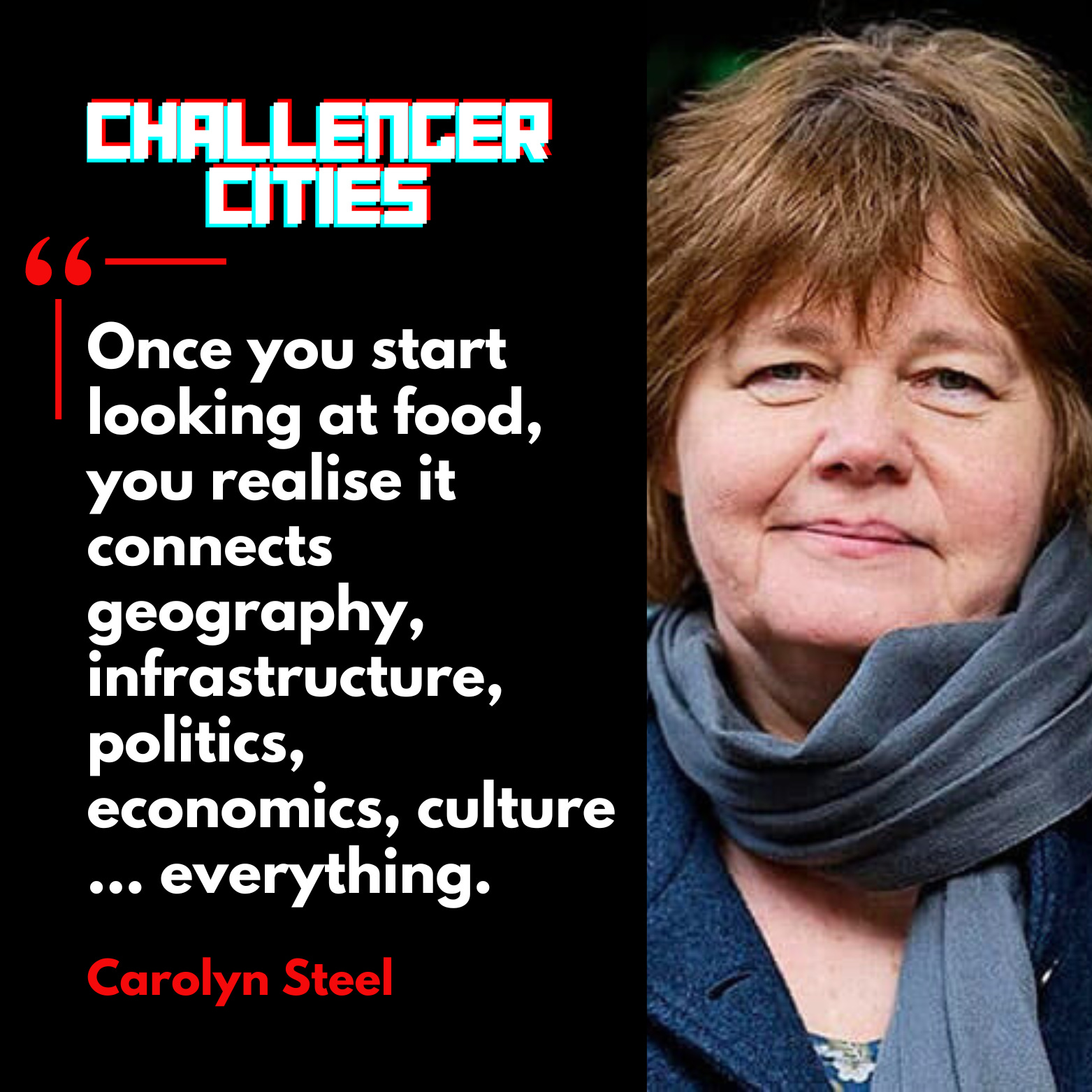
For most of human history, cities have existed and evolved because we learned how to feed ourselves at scale. Farming allowed settlement, settlement allowed specialisation, specialisation gave us civilisation. “Once you start looking at food, you realise it connects geography, infrastructure, politics, economics, culture … everything,” Carolyn explains. The shape of our cities, our politics, our economies, our social rituals pretty much all stem from that original bargain with eating.
And for a long time, that bargain evolved relatively slowly as we adapted ourselves to food, and adapted food to place. Biology, culture and geography stayed broadly in sync with one another. Until life sped up … but more on that as we go.
What makes Carolyn’s work especially compelling though is where she comes from, for she isn’t a chef, a nutritionist or a lifestyle writer. She trained as an architect, but as she puts it herself, “I started to realise that the thing I was most interested in wasn’t really buildings at all.” What fascinated her instead was “our relationship with buildings — the space in between, the mood, the atmosphere, the way places make you feel or behave.” Food, it turns out, became the missing language for understanding that.
If you ask “how do you feed a city?”, you don’t get to stay in one disciplinary lane for long. You’re immediately pulled into questions of land, logistics, labour, transport, energy, trade, power and culture. It’s not exactly simple, or tidy, but it’s fascinatingly interwoven.
That’s why it’s such a useful lens for cities, and why it might be overlooked.
In the episode, we spend much time with four cities as food machines; Rome, Paris, London and later, Chicago.
“The only way Rome could have fed itself, and indeed the only way it could have expanded its empire, was having access to the sea,” Carolyn explains. Grain is heavy, low-value and utterly essential for the time where feeding the city was political survival. The grain dole existed because hunger produces unrest, and unrest topples empires.
Paris had a different problem, as sitting inland on a river that couldn’t support global trade, feeding the city required hierarchy and control. The state imposed itself on the countryside. The king became known as the “baker of last resort”. When harvests failed as a result of climate shocks, and grain couldn’t move, royal legitimacy collapsed with it. The French Revolution wasn’t just about big ideas, it was also about empty stomachs.
London, meanwhile, sat on a tidal river open to the world. It never needed the crown to feed it, it traded, got rich and had a food system that was far more decentralised than that of Paris. Power shifted away from monarchy and towards markets. So we have the same era with neighbouring nations, but radically different outcomes.
Physical geography in a way set the terms for the politics of human geography to cope with.
Then the acceleration of technology development enters the story, and the tone shifts.
Canals, railways and refrigeration didn’t just make food systems bigger, faster and cheaper … but also stranger. Ranching, meatpacking and the rise of cities like Chicago didn’t just fuel the North American economic future, but they reshaped European diets too. Calories became cheaper as meat became abundant and grain production less fragile. Distance which had long been critical to the urban food system, now mattered less.
“Chicago is at the bottom of the Great Lakes, so it becomes this incredible coralling point. Once the railways come in, they just supercharge all of it. And then you get refrigeration — you can refrigerate the railway carriages with blocks of ice cut out of the lakes, stored in ice houses, hanging the meat between them.”
And at some point, the feedback loop between bodies and food began to break.
Carolyn uses a good term for this, ‘exo-evolution’, where instead of adapting ourselves to our environment, we redesign the environment to suit our desires. While technology has allowed us to do that remarkably well, human biology it turns out, is slower to catch up.
“The reason I call it exo-evolution is that what we’ve done is we’ve used technology to stop evolving ourselves, and instead evolve our environment in a way that we think suits us.”
Ultra-processed food, constant availability and convenience without friction is the outcome of systems optimised for scale, efficiency and consumption. Cities are incredibly adaptive machines, but human digestion, attention and metabolism are not, Carolyn emphasises how “we literally end up subverting our own digestive processes.”
Our ambition and ingenuity that has stopped us from starving, or being vulnerable to fragility in the food systems of old, has created new problems. Rather than starving, we’re now at the point where our food is slowly making many of us sick. That whole, “you are what you eat” line is pretty important to think about when you consider the nutritional value of most vegetables is now far less than what it used to be, and that cows fattened up on grain are not the superfood that cows reared more slowly on the grasslands were. Cows and carrots are not what they used to be.
And then we have the social shift.
Historically, markets weren’t just places to buy food. They were unavoidable civic spaces that you went because you had to, which meant you talked to people, gained knowledge by asking, absorbed prices, seasons, gossip and politics. Markets were cities condensed.
The modern supermarket has been designed to remove all of that. Packaging has sanitised food beyond hygiene so that we don’t see where it came from. Conversation became inefficiency, as the product on the shelf started doing the talking instead of the person in front of it, while today’s self-checkout lanes or delivery systems are simply the latest version of the same logic.
“Clarence Saunders, who invented the supermarket with Piggly Wiggly, was very explicit about what he was doing. He wanted to remove human contact from the business of buying food, because he felt that shopkeepers chatting to customers stopped them buying enough butter. So he designs a system where you walk in through a turnstile, you take a basket, and the food does the talking. The food is packaged so that it sells itself to you, instead of a human being.”
People didn’t really notice it at first, but what they lost was something beyond an understanding of the food we’re eating, but the confidence or curiosity around food. We have an abundance of what’s available, but often don’t know what is good, when it’s in season, how to properly cook it and haven’t got the personal networks to ask.
Eating together, shopping together and learning together are all forms of civic infrastructure, low-tech ways of building trust, attention and sociability that most now crave a return to … not just in the form of recipe influences on Instagram or TikTok.
Our conversation, and Carolyn’s books, shouldn’t be seen as an attempt to revert to a departed past, but a call to action that we should be curious about how food has shaped us, and how we should not take abundant food for granted. Cities that treat food purely as a private convenience often struggle with things they pretend are unrelated … think public health, loneliness, social fragmentation and even civic trust.
Places that take food seriously tend to do better on things cities are paying more attention including to like walkability and identity, providing residents and visitors alike with a greater sense of coherence and belonging.
So if you want to understand where a city is really headed, rather than neat set of answers, but a way of seeing cities that’s hard to undo.
If that sounds like something you want to explore further, this episode is definitely worth your time, as are Carolyn’s books which I’ve worked hard to not spoil too much.
Just don’t expect to walk through a supermarket the same way again.
To being Challengers.


