


A few weeks ago I wrote about my experience at Kilkenomics, and how Kilkenny has some of the characteristics of a Challenger City. One of the people I met there, and ended up having an energising chat with, was Peter Ryan. That conversation gave me the idea of inviting him onto the podcast to explore something I’ve been circling for a while, rather than Challenger Cities, maybe we explore a potential Challenger Country.
Ireland seems as good a subject as any. Partly because I’ve got a huge soft spot for Ireland, having made my earliest memories there as a small kid. Peter is American but developed his affection by studying at UCD for his Masters. Although neither of us is Irish, we both carry the country with us in ways that feel oddly personal. And maybe that distance gives us an angle that’s harder to access from within.
Ireland is a place people love to romanticise. The scenery, the people, the pubs, the charm, the craic … all of that matters. But what fascinates outsiders now is its economy. The thing is those astounding GDP-per-capita numbers warp reality more than they reveal it. Spend any meaningful time in Ireland and you discover the gap between the statistics and the lived experience is not a crack (with a ‘k’) but a canyon.
Ireland is one of those places that is constantly talked about yet somehow still profoundly misunderstood.
Part of this misunderstanding is baked into the way people describe its strengths and weaknesses with the breezy confidence of someone diagnosing a distant Irish cousin they met once at a wedding. You hear the same lines everywhere: small country, no real resources, got rich by fortune of the EU, all multinationals, tax tricks etc. It’s the kind of story that survives not because it’s entirely accurate, but because it’s neat.
Ireland is a small country, yes. It doesn’t have the mineral wealth of Canada or Australia. But as Peter pointed out, it also has “lots of land, lots of space for development or potential development” … also a surprising amount of natural gas, but we’ll come to that. The constraints are rarely as tight as they are described. Much of Ireland’s supposed scarcity is the product of inherited assumptions rather than the physical world.
Before we got into any of that, Peter sketched his route into economics, and into Ireland. He came out of the tech and crypto world, drawn initially to the intellectual promise of systems meant to reinvent finance. But the deeper he went, the more contradictions he saw. As he put it, crypto “revealed contradictions all over the place.” That disillusionment pushed him back toward economics, a field he felt was at least attempting to explain the real forces shaping countries. UCD happened to be the right academic fit, but living in Ireland reshaped his intellectual frame. It became not just a place to study but a way of thinking about how nations evolve.
And to understand Ireland, Peter argued, you have to go back to its first decades as an independent state. Modern Ireland with its cautious policymaking, incremental reforms, occasional bureaucratic sclerosis, makes perfect sense when you recognise the conditions in which it was born. Ireland inherited a fragile state, a dominant Church, a small governing class and a society organised around survival rather than economic dominance. As Peter put it, it was run by “a conservative layer of office holders.” There was nothing sinister about it, that was simply the operating logic of a young country, coming out of a messy struggle for sovereignty, with little margin for error.
For decades, that logic went unchallenged. Reform only really accelerated in the 1960s and 70s. Peter pointed to Seán Lemass and later Charlie Haughey as figures who began shifting the nation’s political imagination from pure protection to possibility. They opened the door to industrialisation, foreign investment and the idea that Ireland could be something more than a rural outpost on Europe’s edge.
This inheritance matters because it helps explain the feeling many people have when they try to interpret Ireland today. The country often still feels mid-transformational, being confident in some ways, hesitant or stuck in others. The infrastructure feels perpetually underinvested in, insufficient and unfinished. Reform can moves in bursts rather than waves, and ambitious ideas outpace delivery. Just ask anyone involved with creating a metro system for Dublin. None of this signals incompetence, but more the institutional muscle memory.
It also helps explain why Ireland is so prone to external misdiagnosis. Outsiders see the GDP numbers and marvel. Insiders see the planning quagmire, the housing pressure, the energy bottlenecks, the infrastructural lag, the distortion of those figures by Ireland as a European tax shelter for foreign multinationals and consider how the story sounds so different from the lived reality.
Our conversation turned toward something that challenged one of my own assumptions about Ireland; being the widespread belief that it lacks natural resources. It’s easy to assume Ireland is a farming economy, with Dublin as a financial hub, and some tech investments coming in around the edges.
Peter pushed back immediately. “Ireland certainly traditionally is not associated with having a lot of resources,” he said, “but I would challenge that, because again this is sort of an artificial constraint.”
There’s an interesting fact that makes you question your assumptions though. “When you talk about Ireland you’re actually talking about a place that gained 100% of its natural gas demand from its own offshore waters about 15–20 years ago.” In other words, Ireland, the supposedly resource-poor nation, was entirely self-sufficient in natural gas within living memory.
The reason it isn’t today has nothing to do with geology and everything to do with politics. Coalition agreements meant the Green Party “basically artificially abolished the fossil fuel domestic industry in Ireland,” pushing the country toward near-total reliance on a single pipeline from Scotland. And then Peter delivered the line that rewires the whole picture: “Ireland actually has estimated reserves in greater quantity than the UK in the North Sea.”
In that moment, the story flips, for Ireland doesn’t lack resources. It lacks permission … political, cultural, and regulatory … to imagine itself as a country that has them. Once you see this pattern, then Ireland’s habit of underestimating itself extends far beyond natural gas comes clear.
I asked Peter how he thinks about the Celtic Tiger, because the boom sits uneasily between triumph, disaster and myth. He drew a distinction that rarely gets made with how the growth of the 90s was real; rooted in exports, industry and a society starting to throw off older constraints. But the later growth was more like statistical artefacts. As he put it, those numbers “don’t reflect the reality of the economy or the lived experience.” You can’t eat GDP, a bit like you can’t always build houses with it.
Which led us to infrastructure as arguably the place where the misunderstanding of Ireland’s is most visible. There is a palpable feeling of being forever on the verge of building something, forever announcing, forever consulting, forever about to begin. Projects do get built, of course, see the Motorways of the 90s and early 2000s, but rarely at the speed implied by the country’s economic status. Dublin and Ireland still lack any credible mass transit infrastructure for their growth and wealth. Peter didn’t blame talent or capability, but institutional alignment … “if you don’t have the ability for institutions, for the financial system, for the political system and for the planning system to move in synchrony - if these things can’t align - then Ireland will forever be stuck in this position where it has ambition but not the mechanism to execute.”
Ireland’s institutional DNA was built for caution, not orchestration.
And yet the industrial base is far stronger than the global caricature suggests. The default international narrative is that Ireland is a tax haven with a service economy attached. But as Peter reminded me, Ireland is the second-largest semiconductor producer in Europe, behind Germany, ahead of many nations that pride themselves on manufacturing. “There’s real technical depth there, much deeper than Ireland gives itself credit for.” he said. This is an invitation, for every industrial giant had a beginning, often in small, unlikely places.
The more we talked, the clearer the pattern became. Ireland is not weak; it is under-leveraged.
And perhaps nowhere is this clearer than in housing where Peter went straight to the core. “What comes before the building of houses? Comes before is the money. The money is the credit.” Ireland didn’t lose the ability to build housing, but it lost the ability to finance building. After the crash, as he put it, “the Irish private banking sector in anxious panic looked at the problem of obesity of the Irish housing bubble and responded with the solution of anorexia.” The metaphor is brutal because it is pretty accurate!
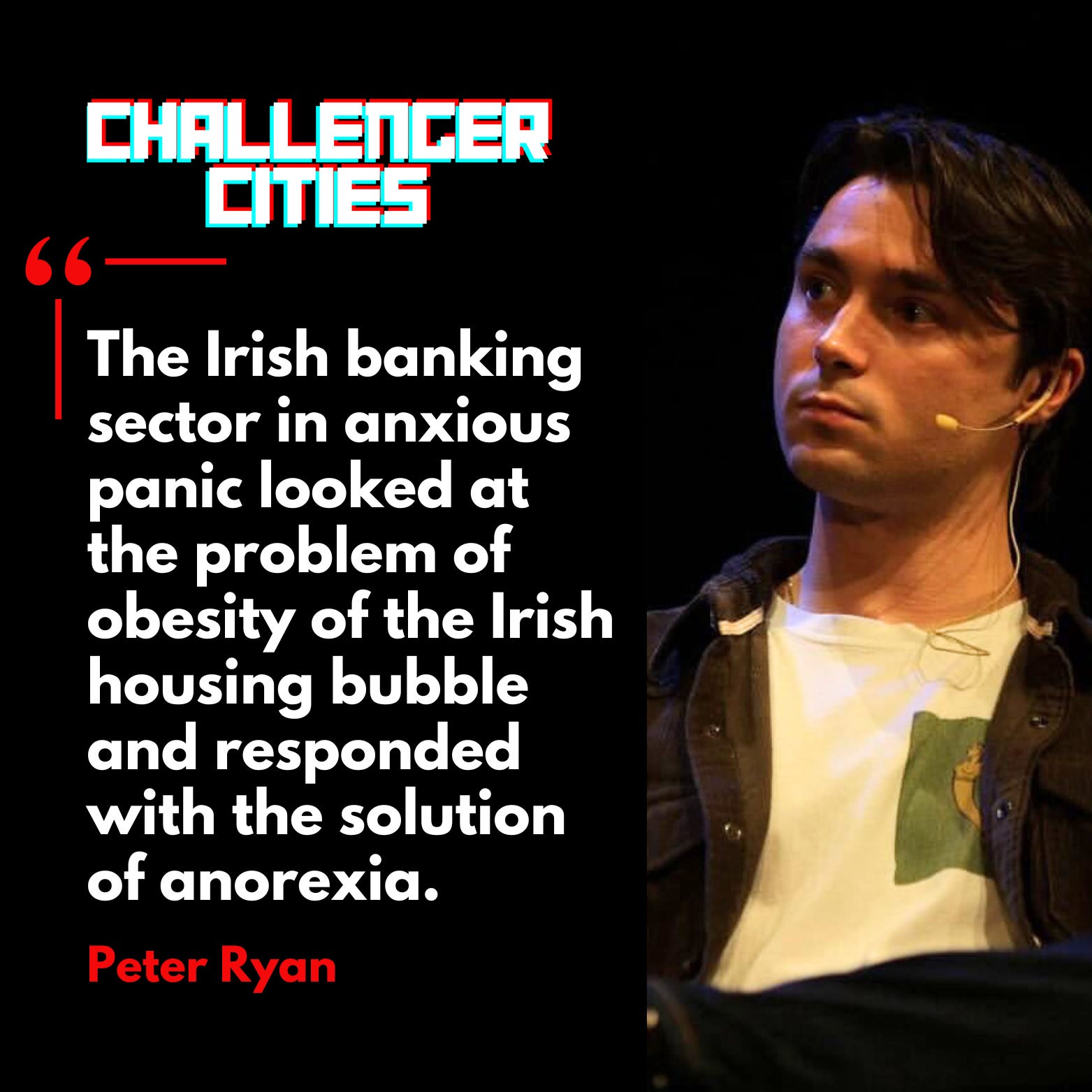
“There is just far too little of private Irish credit being extended to build housing.” he said. You can tweak planning processes all you like, but if credit isn’t flowing, nothing moves at scale.
This loops back inevitably to politics. There is a growing belief, some might say hope, that a change of government from the traditional Fine Gael/Fianna Fáil duopoly, or the ascendency of Sinn Féin or perhaps the Social Democrats will dramatically shift Ireland’s trajectory.
“Young people don’t necessarily have the same alignment with the traditional parties … you’re seeing more movement toward parties like the Social Democrats.” says Peter.
He’s also cautious about expecting to see too much here. “There is so much inertia… and so much outside influence… to keep Ireland kind of frozen as is.” The parties may change, but the operating software remains stubbornly consistent with the state Ireland inherited and slowly reformed.
So I asked him the magic wand question I ask all Challenger Cities guests, extracting a bit from the realities and constraints, what would he do?
Peter started with energy, because dependence on a single pipeline is a strategic constraint. Remove that bottleneck and other systems unfreeze. Next came industry in expanding semiconductor capacity and strengthening the industrial spine that already exists but rarely gets discussed. Then infrastructure as the connective tissue of a modern society. Build momentum, and only then push into decarbonisation at scale, not as austerity but as investment.
Only really towards the end did we talk about Ireland’s diaspora, strategically as opposed to sentimentally.
“The population of 5 million within Ireland is actually dwarfed by the population of the diaspora that exists in the world, probably another 10 to 20 million Irish expats that were born inside Ireland, and then when you’re talking about plastic paddies … generations removed whether America, Canada, so forth. That’s a total population of 70 million and a huge brain trust for Ireland to tap in terms of new ideas, economic innovations … creating networks to feed in and create feedback loops to each other.
We shouldn’t see this as nostalgic, postcard Ireland, but instead a superpower of a global nervous system of skilled talent and influence.
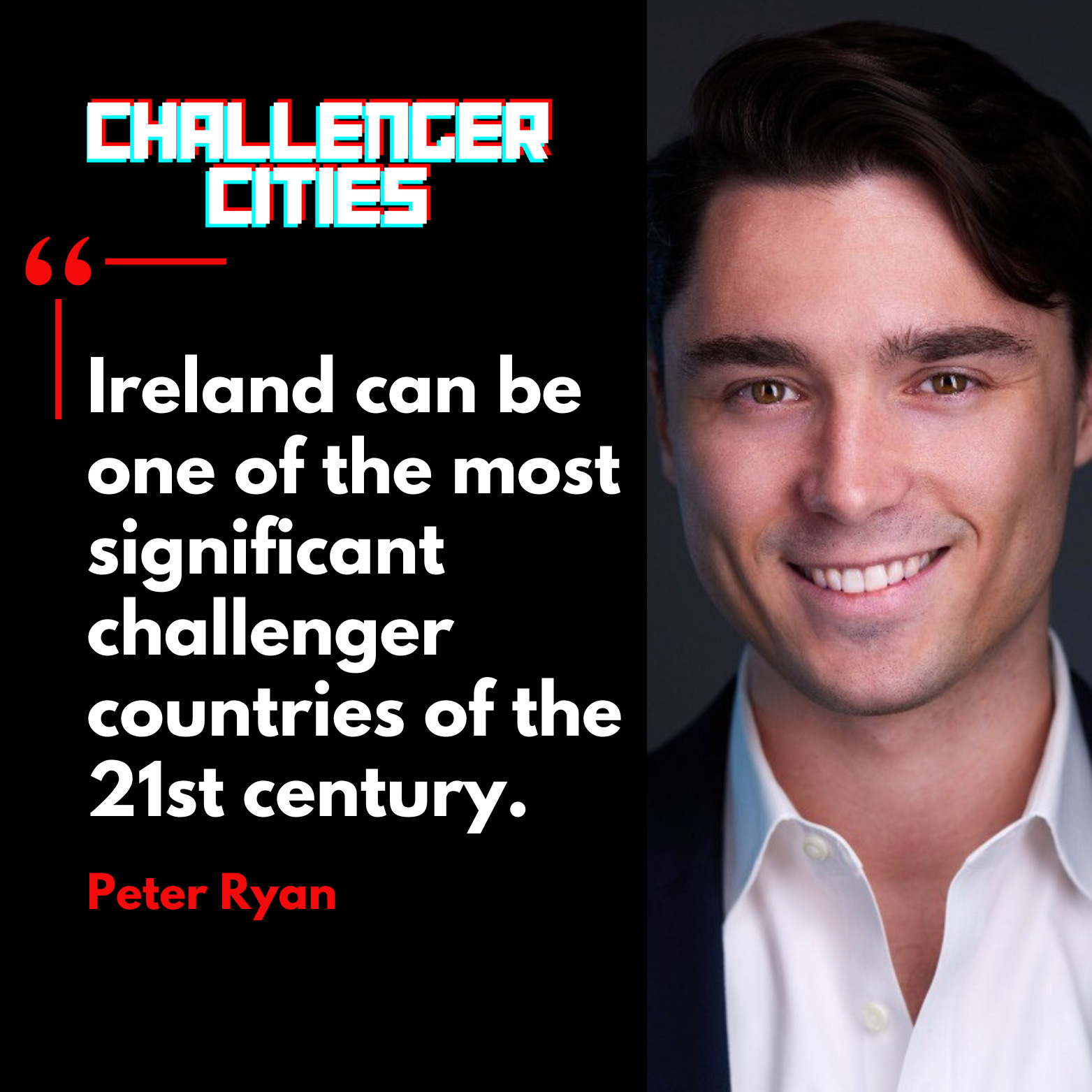
By the end of our chat, Peter is on his soapbox, full of energy. “That’s why I think Ireland can be one of the most significant challenger countries of the 21st century.”
Not because it is scrappy, not because it is small, and not because it is charming or cleverly tax-efficient. But because Ireland is a country whose story has not yet caught up with its ingredients, a nation whose constraints are misunderstood and whose assets are underused. Ireland is the Challenger place built from caution that now finds itself surrounded by reasons, and opportunities, to be bold.
A Challenger Country, if ever there was one.


