


I met Stratton Townley at the Waterworks Food Hall in Toronto on a weekday morning, a couple of hours before it technically opens. There were ten or twelve people sat about, most with a coffee, a book or a laptop or having a chat, and nobody took issue to them being there.
It’s an interesting spot, and I hadn’t really known the building was there back when it was more or less derelict. Stratton said he didn’t either, as he drove past it for two or three years before Woodcliffe bought the site without clocking it.
So we have an old building nobody noticed, in a city that has been starving for heritage assets turned into something new. They exist, they do well, but many were also knocked down or just retained a bit of an ersatz facade.
Stratton is Vice President, Investments & Corporate Strategy at Woodcliffe Landmark Properties, which his stepfather Paul founded in the mid-nineties and his mother Eve has run since Paul passed away in 2011. I thought it was interesting as Stratton spent his first decade avoiding all of it, and his surname meant he could keep quiet about the connection. He did office leasing and then investment sales, but his own verdict on those years is that he learned how real estate gets priced, but cared more about how it gets made.
The bit I enjoyed most is why he never became an analyst at one of the big shops, which was a bit of that graduate ambition where he went for the job and got told not to take it.
“I’d be jumping out of my seat in six months.”
All too often it’s actually rare to see this kind of reasoning, especially in (small c) conservative Canada. Those firms do pay very well and they want people to stay, but the way they achieve it is that “for you to be siloed in a specific asset class in a specific part of a project.” Pre-development on office, say, and that’s your lot. Thirty minutes of conversation was enough for this gentleman to conclude that Stratton “would want someone else’s job” and “drive everyone crazy”. Stratton thinks he took it personally at the time, but now cites it as one of the most useful things anyone has ever told him.
Hold on to that word siloed, because it’s important for the conversation and some of the difference when you work for a smaller developer that holds a bit of a different philosophy. Woodcliffe has a small staff, is private and carries no debt. The story from Summerhill … or Rosedale, if you want to be accurate about it … played out over decades is important.
Thirty years ago Woodcliffe took roughly eighteen hectares off Marathon Realty, but they were too small to develop any of it, and so sold parcels on in order to retain the Yonge Street frontage, and maintain control of the prime frontage. Some of the projects there such as the LCBO in a very tastefully redeveloped station, or Summerhill Shops, are an example of a mindset where a little more care, craft and longevity has been retained.
It’s easy for urbanist types to be rude about developers, and sometimes, it’s very fair … but I don’t think the problem can be attributed to character. Most firms are built with the rational move being to get in, get approved and get out, fast. Publicly listed entities get judged based on their quarterly and annual performance. The leveraged ones answer to the clock or calendar of the lender. Stratton describes the era when a firm’s whole competence was entitlement rather than construction, where “their whole DNA was how do I deal with the city?” and the product was an approved site sold on to somebody else … “There’s a lot of companies that never intended on building sites.” Nobody has to be a villain for that to end badly. It just needs a 3 year horizon, and the incentive stops being to make something good and starts being to be finished.
Change the time horizons and you change what a firm is able to care about.
“it allows us to care about things that don’t fit onto a spreadsheet”
Waterworks is where you see what that buys. 297 condominium units, with 17 of them affordable, a YMCA, the Eva’s Phoenix youth shelter, and a food hall with a basement dug specially underneath so the back of house stays out of sight. 11 years went into that, and the hospitality side of things keeps Woodcliffe involved. Most developers register the condos and they’re gone. So this is partly a story about a developer discovering their next act, in a new part of the city.
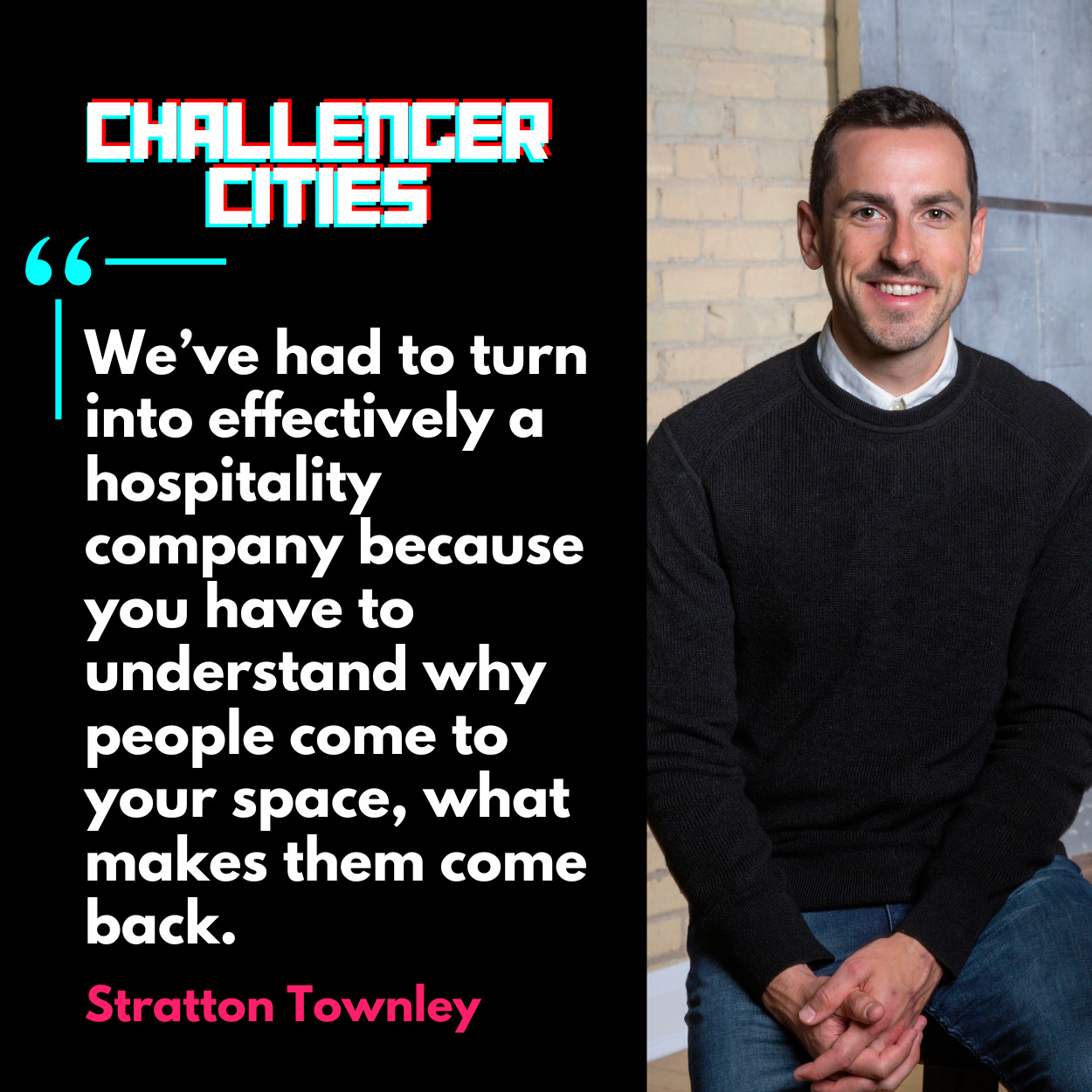
“we’ve had to turn into effectively a hospitality company because you have to understand why people come to your space, what makes them come back”
“Someone judges you the second they walk in the door.”
Development lets you believe the job ends when a project is delivered. You can also get “years to tinker with your plans”, then a ribbon to cute, then you leave and nothing good or bad that happens in the building afterwards ever reaches the people who created it. Hospitality is a much faster feedback loop. “In hospitality, you’re learning every single day”, and the learning has somewhere to go, because you’re still there tomorrow to act on it. The tenant mix stops being a series of people that pay you rent, and becomes the product itself, that will change over time as some entrepreneurs thrive, others perhaps struggle and the world moves on.
Most developers aren’t actually exposed to whether they got it right over time, which is a rather strange way to frame the act of citybuilding. The lessons might get learned from whether a development made money as it was flipped, but not what it was actually like in terms of life for the city and its citizens.
But if you’re a developer that hangs around, operates under a different timeline and has as much the mindset of an operator, the feedback reaches you and you can do something with it. The food hall is a good example of it being played out. The team then visited virtually every notable food hall on earth and then turned the standard food court layout inside out … most put vendors round the edge with a pit of seating in the middle, and Waterworks have the food in the middle, and nudges the guest to to eat at counters or tables that have them looking at the food. And the vendors are well curated, so it does lean premium with an omakase counter, but also an affordable slice of pizza.
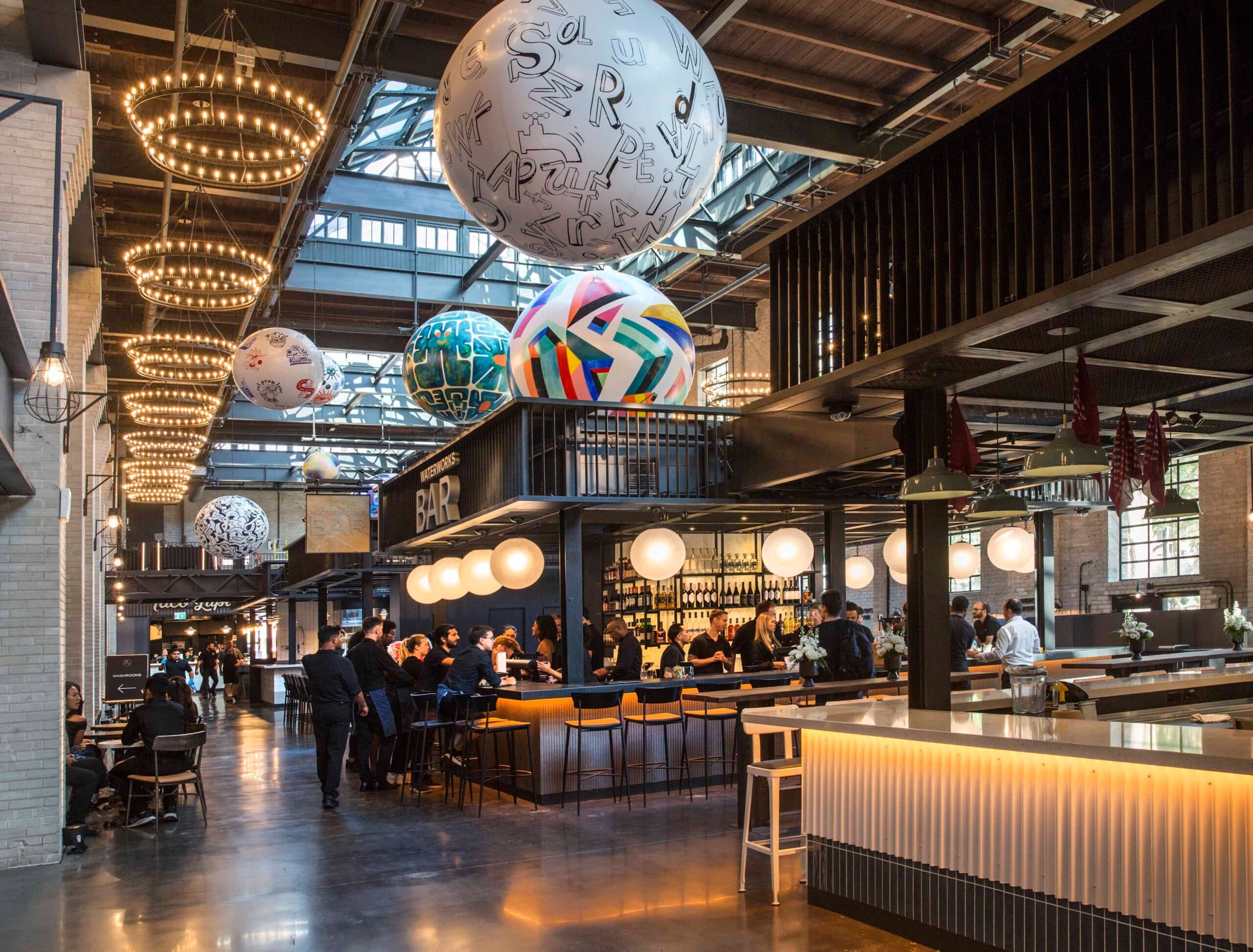
You can have a martini, or get a drip coffee, so there is variety. As I saw in the morning, it can be a quiet and reflective place to sit in the air-con or out of the rain.
“what’s the harm in allowing people to have a space to enjoy themselves?”
It is actually rare for ground floor spaces in Toronto to work that way. Most lobbies are empty spaces, hostile to people from outside, and places people rush through when they live or work in the towers above.
We get on to things like European stations having proper bars in them, and why North American ones don’t, and the silo mind is back … “everything kind of operates in these silos where it’s like, hey, well that’s what this is for. So it can’t have something nice in it.” The careers siloed by asset class, in an industry where buildings are siloed by use. Is that the same disease, but different scale?
In some ways it makes the Waterworks more impressive as “an industrial building that the city never expected people to enjoy being inside of”, as the whole project shows this in design touches like the windows being lowered, and bringing light into a space that is now for people rather than industry.
This craft isn’t new to the company. Stratton references how The Shops of Summerhill have “heated limestone and granite sidewalks out front of those stores. You don’t have to shovel them.” This was a privately financed benefit, which the city said no to at first. It’s proven by how the tenants are there for the long term, and how it will bring people out that wouldn’t otherwise come out on a cold, icy or snowy day. Ok, yes, this is an affluent area, where people have a little more means, but maybe spending the money is worth it as it creates little honeypots. This leads us to talk less about individual projects, and more about the city hosting them.
Toronto is a bit of an oddity, for approvals take longer than nearly anywhere. Despite that, the skyline of Toronto is one that shows more is being built than almost anywhere. Developers attest to the first answer from the city typically being ‘no’, usually on the authority of a policy written for a world and a city that has changed, with municipal agencies walled off from their peers. So the silos are there again in the system. Stratton would happily help to maintain the park his building shares a lot line with … clear the litter, cut the grass, do the landscaping … and “the city doesn’t like that.” There is the juxtaposition of the private realm that can be maintained better than the public one.
What I admire is that Stratton is born and raised in Toronto, committed to the city, an optimist for the future, and he doesn’t do the developer-versus-city routine that would be so easy from where he’s sitting. He will fight the specific fights, win some of them and think pragmatically for solving the next challenges. Anyone can be negative about Toronto, I know that. People can also leave, I’ve done that. It does take people to push for change and stay pleasant enough that the city will take their call and work with them.
Our conversation leans more into Toronto, and some of the current challenges or symbols of what is or isn’t working. When we talk big visions, Stratton considered the waterfront.
“Everyone is on a two or three, four year cycle and no one is willing to stick their neck out and commit to something.”
You could consider this the family business frame of time being applied to the political one. He’s describing an institution that can’t hold a thought for longer than an electoral term, and he’s describing it from a firm that has held a parcel of land for decades. We talk about the contrast of the reclamation of the Don, prompting “wow, Toronto did something” to the island airport where things have “gone in the direction of how can we monetise it and target the smallest group of people that benefit”.
We landed on the same frustration from opposite ends. Vancouver’s waterfront is beautiful, but it lacks attraction or amenity. Meanwhile, London’s South Bank has some of Europe’s great cultural institutions as well as spaces to go for a walk, or just take a seat. Toronto seems to struggle to figure out that balance of the waterfront as a park, but also a place to meet, sit, eat, play, see, do, spend … oh, and easily get to and from.
So the biggest possible thing is a waterfront somebody commits to beyond a single electoral cycle, and a city that can tell the difference between a firm planning to be here in thirty years and one planning to be gone in thirty-six months. It means the smallest possible thing becomes the details.
“no detail is too small at the end of the day”
What he means by it is something I don’t think people expect enough from a developer, often because a lot of developers can be hurt if they don’t get the credit.
Stratton applies the analogy of your garden, which you put care into not to prove you own the best house on the street, but because “it might be just to make someone’s day that you have nice flowers out front.” Every patio at Waterworks is planted and maintained long term with that logic.
He says the details “are reminders that it’s worth pushing back or fighting or having that next conversation with the city.” The windows onto the park at Waterworks originally sat twenty feet up, letting light in and showing you nothing. They fought to punch them down to park level, on the property line.
“someone’s experience with Waterworks for the next hundred years is now better because of that conversation”
“a lot of people will just give up and say, you know what? It’s not worth it. I think it’s proof that it is worth it.”
So go and have lunch at Waterworks if you’re in Toronto. And feel free to turn up early, hang out, and enjoy a calm space for a moment.
To being Challengers.


