



Michael Schabas decided at the age of ten that he wanted to build railways, which he cheerfully points out, is a career almost engineered for disappointment. Railways are rather expensive to build, we already have quite a few of them and the new ones get built about once a generation.
He trained as a transport planner anyway, kept architecture in his back pocket as a fallback, and then got spectacularly lucky with his timing. Cities started building new metro systems again. He landed on the team building Vancouver’s first SkyTrain line, the world’s first driverless automated metro, as a twenty-something sitting beside the people deciding where the stations went and how often the trains would run. It opened in four and a half years, worked from the first day and has gone on to be one of, if not the best, North American system today.
What followed is the sort of CV that will suggest he might be a man worth paying attention to, for it includes; Canary Wharf and the Docklands Light Railway, The Jubilee line extension — he designed the route and built the business case that persuaded the British government to pay for it, four years on the team building Britain’s first high-speed line, from London to the Channel Tunnel. Then he went and founded an actual railway company, won a privatised franchise, turned a money-losing London–Norwich service into a profitable one while lowering fares and growing staff, started a freight operator that is now the largest in Britain, and rescued Australia’s long-distance trains by turning them into something that makes money to this day. Back in Canada, he badgered Toronto into electrifying GO (ongoing!), and more or less invented the Ontario Line at his kitchen table over a Christmas holiday.
I think that probably earns him the right to be frustrated with the state of rail in Canada today, and he is frustrated. Because the question everyone keeps asking him of “why is there still no fast train between Montreal and Toronto?”, the biggest two cities in a country separated 500km apart, when Morocco, Uzbekistan and Turkey and soon Vietnam will have exactly that — has an answer that is both simple and maddening.
Today, between those two cities, you get six diesel trains a day, scheduled to take five or six hours, late by an hour about half the time, and somehow also still an expensive way to make the trip. The fares look European on the website but work out the average and they’re about double, and the railway still loses money! Meanwhile, modern European HSR systems actually make money! … not necessarily enough to pay back the tracks, but significant operating surpluses, because, as Michael puts it, every additional passenger is “a hundred dollars to the bottom line.” So why not here?
Well it’s because the thing requires someone who understands the whole of it from what everything costs and what everything’s worth, across the entire spectrum … and there are almost no jobs that produce that person. The rail industry is gloriously over-specialised so the signalling expert doesn’t know how to timetable, the timetabler doesn’t understand fares, the fares person knows how to set a fare but not how you actually sell one to a customer.
His analogy is the one that lodges in your head. Imagine you buy a lakeside plot, see a lovely house in a magazine, and hire a carpenter, a plumber, an electrician, a bricklayer, a gardener etc.. They all say yeah, no problem, we do houses like this all the time. And they’re all telling the truth, and you will still end up with a disaster, because “You need an architect. You need someone who knows how to put it all together.” Others might call this person a producer or general contractor.
Canada keeps assembling teams of people acting as specialists and forgetting to hire the generalist that can actually architect or orchestrate the thing. If this sounds familiar, it’s what I’ve recently been calling the ‘infrapreneur’. Michael describes himself as “a railway architect. I don’t design stations, I design railway systems.” Or, when he’s feeling less grand, “a truffle pig”, as the one who can go and find the buried treasure.
So where’s the treasure? It starts with two of what he calls his laws of railways. The first: “if you’ve seen one railway, you’ve seen one railway. They are all different.” Power stations might be relatively interchangeable, or perhaps better, McDonald’s franchises are interchangeable, but railways are not, because each one has to serve a unique geography, population and set of travel patterns. The second, hard-won over decades of his own failed attempts of “railway alignments are found and not made.”
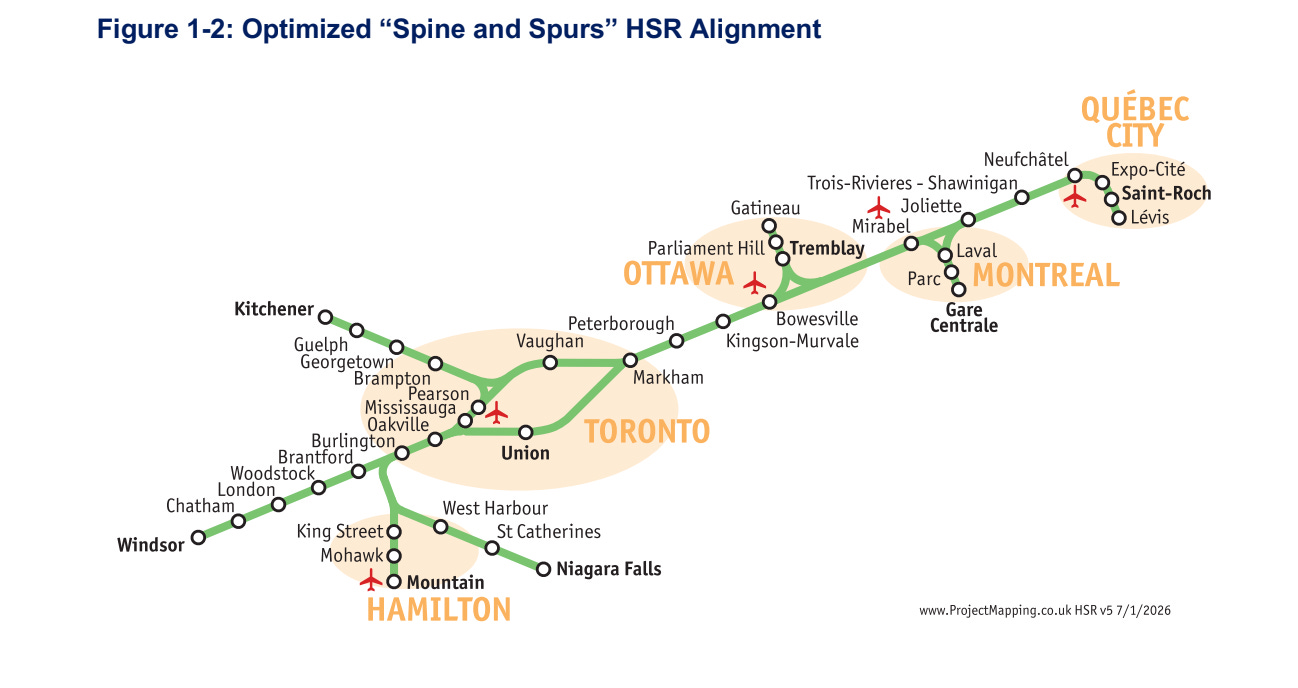
For fifty years people, Michael included, tried to draw a line that loops Toronto through Ottawa to Montreal. Only recently did he realise the answer of “you actually build a railway from Toronto to Montreal and you put a spur up to Ottawa.” Trains to Montreal go straight through, while trains to Ottawa turn off, then come back. This isn’t heresy for it’s how Frankfurt, Milan, Rome and Manchester are all served. You build less railway, and the people who aren’t going to the intermediate city get bypassed. He points this out using the comparison of the plane, for “when you take a plane from Toronto to Montreal it doesn’t stop in Ottawa on the way, does it?”
The other piece of treasure is the ground itself. VIA has spent half a century trying to upgrade freight tracks and thread trains down old corridors and highways, the way you’d have to in England or Japan where there’s no room. But most of rural Ontario and Quebec is wide-open country, and the last thing you want is to build where things already are. It’s cheaper to lay track across a field. The cost of much of the land is really a rounding error in the grand scheme of things - maybe a million a kilometre - against the $30–50 million a kilometre that good open-country high-speed rail costs. Start following an existing corridor and you might double that. Go into a city, double it again. Into a tunnel, $500 million a kilometre. Nobody takes the time to break it apart like this, so they reach for an average of total cost divided by total length across twenty railways and produce a number that means nothing. Do the work properly and a greenfield line turns out to be quite cheap, in the way that fifty million bucks a kilometre is cheap.
Next comes the fares argument. The objection you hear, quite loudly lately from Pierre Poilievre, is that this will be a train for the rich, Laurentian Elite corporate and political types. The honest answer shouldn’t be a vague promise of “a range of fares”, but that a high-speed electric railway is so productive, and can have such capacity, that Alto could simply commit to average fares lower than VIA charges today.
The French already prove it as their high-speed average fare is about a third below what VIA charges now. Check Paris–Lyon and the gap between the cheapest and dearest ticket is €19 to €190, “a ten to one ratio,” Michael says, “and that’s what it should be.” You charge the business traveller who wants the window seat, the meal, the table space and the last-minute change a few hundred dollars; but you charge the student who books three weeks out, doesn’t care what time of day, and is prepared to be packed in a little tighter, as little as twenty dollars.
You don’t kill the premium product; you stop leaving the entire bottom of the market on the table. This is an issue with the current North American rail product, for VIA and Amtrak are pretty generous with their economy or standard class. It’s much more premium than standard class on LNER or a TGV. So why not create a value class carriage or two, that helps capture a different market segment.
I sat in a conference once watching an Amtrak exec present how they were maximising the price they could charge for a ticket on the Acela in the North East Corridor. He was proud that he’s increased his fares and ended his presentation with muted, polite claps. At the same event, VIA Rail talked about a new website. Meanwhile a man from SNCF’s budget brand Ouigo came up and explained how he runs a profitable railway selling some tickets for as little as nine euros. The North Americans looked at the Europeans like they’d been sniffing glue selling tickets so cheaply, while the Europeans looked at the Americans like they were morons.
But building a new railway goes beyond the fares on the trains, or how you fill those trains to justify the project. We also need to think about stations, and the developments they catalyse, like housing, which is where the politics get interesting. Alto’s instinct, echoed by its CEO, is to minimise intermediate stops to protect the headline city-to-city time. But the maths runs the other way once you stop treating every train as identical. Stopping at Kingston adds about ten minutes, which might cost you 2-3% of your through riders, but also gain you roughly four times that many new ones, because Kingston ridership is high even on today’s terrible service. The trick, which every mature system uses is that not every train stops everywhere. Maybe one an hour straight through without stopping, another one calls at Peterborough and goes via Ottawa, one that calls at Kingston, one stops everywhere.
And the stations themselves go beyond the place you get on or off the train, as they’re about land.
"When people talk about building houses more cheaply — well, we're not going to get the carpenters to work for less, we're not going to make bricks a whole lot cheaper. It's land. When it comes right down to it, it's land. The reason it costs so much to live in Toronto or Montreal, compared to say Edmonton, is the land cost. So we need to build railways where the land is cheap, and then run commuter trains from those places into the big cities."
The reason Toronto and Montreal are unaffordable is land cost, and the way you build housing cheaply (and quickly) is to build where land is cheap and then run fast trains into the big cities. Alto boasts about enabling 60,000 homes as though it’s a big number. In the scheme of Canada’s housing deficit, it’s absolutely trivial. Done properly you could build 60,000 in Peterborough alone, and another 60,000 in Kingston, and again in Brockville. Each intermediate stop could become a city of half a million, as places companies or academic or public sector institutions actually relocate to, so they’re not just bedroom communities, because key staff can commute out to them in forty-five minutes.
It’s the Bologna–Florence story, the Madrid–Zaragoza–Barcelona, Lille-Paris, story where you stitch separate labour markets into one. There is immense value there where the gains of such previously impossible benefits are what really justifies building the project.
That brings us nicely to the line that gets thrown at every megaproject where big numbers are very quickly challenged. So if this thing costs $100 billion to build, while generating maybe $1.5 billion a year in surplus, people will say that’s a terrible return. Michael’s answer is patient, because a billion and a half, growing, pays back maybe fifty billion of capital over time. The remaining gap, set against a million or two million new homes (that likely otherwise couldn’t be built) along the route, works out to around $25,000 a home, which is a pretty small number. Add the agglomeration, the avoided road-widening, the economic relocations, the simple fact that someone in Ottawa could take a job in Montreal (and vice versa), and the case stops being about the operating surplus at all. I keep coming back to the same point: the business case can’t see the behaviours that don’t exist yet. The Elizabeth Line was forecast to fill up gradually but instead it stampeded with over 500 million journeys in three years, a third of them trips nobody would have made at all. The model can often only imagine faster versions of today’s tedium.

On which note, Michael and I are in violent agreement about business cases, namely that most of them are, in my words, completely bullshit. The point is very much more about the thinking exercise of doing a business case, rather than the end artifact itself.
“A business case is an exercise to prove to yourself that the answer you’ve got is a good answer and is better than the alternatives … it’s a way to validate your instincts.”
A business case will not tell you what to do. You can’t business-case your way to a good solution if you’ve started with a bad one. The number is almost a theatrical flourish, because it’s effectively writing as thinking. Which is exactly why his alternative business case, the one with actual spreadsheets, actual cost-per-kilometre rates, several route alignments and an honest “I was wrong, I should have gone through Kingston after all” as he revises it soon, is worth more than the official forecasts. He told me, almost wistfully, that hardly anyone ever asks to see his model or how he worked out the variable cost per train-kilometre. The people whose job it is don’t seem to spend a Sunday afternoon wondering how to make this one in several generation railway project better.
That annoys me because it’s also what frightened me at the official public consultations. Ask about station design and you get we haven’t got around to that yet and ask about the route and you get that’s what the politicians told us, so we’re doing what we’re told. Compare that to a fellow like Thomas Ableman and the volunteers spending their Sundays working out how to bring Swiss railway concepts to Derbyshire. That’s where change actually comes from, and it’s almost entirely absent from the way we’re building a far more expensive project in Canada just now.

There are real risks Michael won’t paper over too. The concession model puts Air Canada inside the consortium that will set the fares, on a railway with no competition. “Will they set the fares to maximize ridership as well as revenues? Or will they just set the fares to maximize profits?” There’s a reason Spain’s Madrid–Barcelona ridership tripled only once liberalisation forced the incumbent off its one-train-an-hour, revenue-maximising perch. There’s the engineering culture’s instinct to keep the railway pure by not wanting commuter trains on our tracks with two signalling systems and the impact on reliability … yet there are literally hundreds of sections across Europe where high-speed and local trains share track perfectly happily.
It’s the same instinct that had Crossrail’s team declare they wouldn’t serve Heathrow because “airport passengers don’t mix well with commuters.” They were right that the two don’t mix; they were wrong that the answer is to wall them off rather than design for it. Optimisation is really a set trade-offs and design challenges. We see that lack of a design culture that gave Toronto a UPExpress with overhead luggage bins on an airport train that Michael states “are never used,” a station too cramped to move through, and a queue to board as though you’re catching a flight.
"I think the opportunity is fantastic. And in a funny way, high-speed rail isn't that complicated — as long as you get the overall vision and technology right, the components can be done separately. That makes it quite different from a metro. An urban metro has to be a single machine; there's no flexibility. So you can build this in stages, you can build Ottawa–Montreal, you can interoperate different kinds of trains on the same tracks, which you can't really do on a metro."
Michael is keen to look seriously at bi-level double-deck trains, because you carry a third more passengers for the same money. (The operators who say passengers don’t like the stairs have clearly never met my wife, who refused to sit on the lower deck in the Netherlands last week.)
And Michael’s imagination keeps going west with Calgary–Edmonton, then a line through the Rockies to Vancouver. “If this was Austria or Switzerland, they would have already built the railway between the two.” We could even see several million people moving to the interior of BC. Something that might even help with the cohesion of a country currently arguing with itself.
We should also think about the smallest thing we can do right now to realise those visions. For Michael that means go and learn properly as Canada keeps looking at three other railways and declaring the lessons don’t apply. Look at thirty instead. The recurring villain in How Big Things Get Done, which Michael had just reread and I’m about to, is the Sydney Opera House, designed by an architect who’d built barely more than a garden shed, twenty years late and ten times over budget. The hero is Gehry’s Guggenheim Bilbao, on time and on budget, because by then he’d already made every mistake there is to make and “knew all the mistakes not to make.” Canada needs to go and borrow other people’s mistakes instead of paying full price for its own.
This is perhaps the common thread for me. Michael’s “architect” as the joined-up generalist who knows where the value is and how to get it, is the same role I keep banging on about under an uglier name, the infrapreneur. It’s the person who sits between the economists justifying the cost and the engineers chasing the speed, and asks the question neither discipline owns: who is this for, why will they choose it, and what previously impossible thing does it make ordinary? Alto has lots of economist and accounting, it has lots of engineering types, it has many indigenous reconciliation people. But it doesn’t have a proposition design team, or a marketing department, or a customer insights team. It conspicuously lacks the architect of the proposition, and every number in that business case is therefore resting on a proposition nobody has yet considered designing.

Michael’s own document puts the stakes more bluntly than I would dare: better to build nothing than the wrong system. I don’t think we’ll build nothing, and I’m relentlessly pro high-speed rail for Canada, but I’ve just grown louder as the project has drifted, because we are doing it the wrong way, and the wrong way is the most expensive way there is. A train this consequential is on its way to being the most important piece of infrastructure built in this country in several generations. The question of what it’s for - beyond fast, efficient and clean - is the question that decides whether it earns its investment, its political cover, its riders and its place in how Canadians understand themselves.
You can find Michael’s alternative business case here, and he’s about to release a new version with Kingston, Belleville and Brockville added in, because he went back and decided the locals were right. Which is, when you think about it, exactly the posture this whole project needs more of.
To being Challengers.


