


I want to get something out of the way early. I like cars. I really do. I just don’t much like cars downtown. If you spend enough time making the case for cycling or public transport, people assume you’ve declared war on the car and everyone who ever owned one. So it felt right to start a conversation about the coming of robotaxis with someone who has travelled the full arc; from a sixteen-year-old who couldn’t wait to drive, through fifty years and a string of cars he genuinely loved, to a man who now, in his own words, doesn’t want them on his street.
Bern Grush co-authored a book called The End of Driving. And the first thing he’ll tell you is that the title gets misread too.
“It’s not the end of cars. It’s the end of driving. It’s the end of human driving.”
Cars, he insists, are a magnificent invention and they aren’t going anywhere. He even reckons we’ll travel at least as many passenger miles in a steel box as we do today. “Cars themselves are perfect,” he says. “It’s what we do with them.” Which is to have too many, too big, too fast, everywhere, too loud. The machine was never the problem. What we ask of the space around it is.
Bern arrives at this from a useful angle as he trained in human factors psychology and systems design engineering … half of him thinking about how humans work with machines, half about how machines work with humans … which accidentally made him for this work. He spent a decade on AI image analysis for satellite imagery back when “AI” meant something laughably primitive next to today. He invented and patented an in-vehicle road-pricing device that was all set to go live in the Netherlands until, in a genuinely bizarre piece of geopolitics, Obama’s surge in Afghanistan toppled the Dutch government, took out the transport minister, and took his contract down with it. An international war killed his startup. He was, he says, “down for a couple of hours.”
Then he noticed sidewalk delivery robots, got worried not about the device but about its behaviour in public, and having done standards work since the 1980s, went off and chaired the ISO series for, among other things, robotaxi pickup and drop-off. Across four years of it, what he found is that almost nobody thought the topic mattered as the prevailing belief was that these vehicles are smart, so they’ll figure it out.
Only, they don’t. A Waymo drives down the street better than an Uber driver. But ask it to find a place to let you in or out, Bern points out, and the human wins easily. The intelligence everyone marvels at stops precisely where the trip meets the city.
We spent a few minutes talking about form factors of autonomous vehicles. The Waymo Jaguar I-Pace still devotes a quarter of its interior to a driver who isn’t there. Bern finds the spinning, driverless steering wheel funnier than the empty seat: “Look-Ma, no hands is laughable, but Look-Ma, the wheel spinning around on its own.” It's there, he says, because we slapped a Band-Aid on existing machines just to try them. The mistake is to judge the whole future by these first awkward attempts: "We're at the Model T edition of this."
Zoox, a reimagined box that was never a car in the first place, is more honest about where this goes, as is a little Chinese toaster-on-wheels called Pixmoving already running a fixed micro-route in Riyadh. Why four seats? Why not two? Why not twelve?
It’s good sport, but it might also be beside the point. Teslas, Waymos, Zooxes and Fords will hoover up the attention because they’re the physical things you can see, sit in and touch. Whether any of them work in a city depends on something far less photogenic, relating to the connective tissue to the place. That means the moments you get in and moments you get out, including here you get in, where you get out. Almost none of the care and money being poured into the vehicle is going there.
Here is the reframe the whole episode turns on, and it’s deceptively simple. When you own a car, you are buying the trip including the status, the feel, the reliability, can-I-fit-the-kids-and-the-kayak. When you use a vehicle as a service, your attention moves entirely to the endpoints. Where do I start? When does it come? Where does it drop me?
Bern stopped driving a few years ago, sold the BMW he loved, and felt his own mental model shift. “It changes everything about that experience and about that safety and about that comfort,” he says, “and we don’t think about those things.”
And then he did something I appreciated, because it’s exactly the move that separates a clever observation from a serious one. He widened it past his own comfortable vantage point.
“Try to imagine yourself a woman, and you need to go to a place that’s a little bit dicey, and you need to be let off at the door. You are not willing to walk three blocks through this particular area.”
Suddenly the endpoint isn’t a logistics detail; it’s whether a journey is available to you at all. The same is true for the wheelchair user who needs an accessible spot, or the blind passenger who can’t be made to cross the road to reach one. We obsess over the autonomy of the vehicle and ignore the autonomy it actually grants or denies the person inside. Marketing never helped as nobody has ever sold a car on how lovely it is to be in the car park.
So who is responsible for the endpoints? In transit we have the same blind spot as the train operator’s job ends at the station, never mind the office, museum, hospital or bar the passenger might actually be heading for, and we’ve imported it wholesale into the automotive world.
I told Bern about a scene I watched the other night near Spadina and Bremner, leaving one of our events as the Toronto Blue Jays game had just ended, with Ubers stopping dead on the junction. Police trying to move them on, passengers still clambering in, and a driver, terrified of a ticket, beginning to pull away with the door open. Everybody behaving rationally for their own goal, the sum of it faintly lethal. Bern called it the Keystone Cops. We are all set against each other because the glue is missing.
“The glue is that the city says: here’s the behaviour we want. If you want to operate in our city, here’s the place — and we’ve given you plenty of places to stop.”
We haven’t, of course, because the kerb is already full. We’ve primarily built it all for parking, squeezed in a hydrant and a charging point, and now we want it to absorb bike shares, scooters, cargo bikes, delivery robots and robotaxis too. Maybe the odd planter or pocket park as well. “There’s just not enough space for this,” Bern says, and it lands as a genuinely uncomfortable piece of arithmetic. A thousand robotaxis, doing twenty-five trips a day, with two endpoints per trip, 365 days a year … that’s eighteen million pickup-and-drop-off events a year, each one a candidate for the little clot in the traffic you can literally watch backing up a block. Toronto, he argues, is right to keep its foot on the brake for now, but it is wrong only if it thinks the answer is “never.” British Columbia banned Uber for a decade; that’s not governance, it’s flinching. “It’s not a mistake to say: you cannot do it until the following is in place.”
We should not be copying San Francisco’s surprise by making the same mistakes, but learn from them and thinking what’s our next practice, not assuming somewhere that moved earlier has the best practice.
What makes this more than a planning lament is that Bern has found the lever, and it’s a fiscal one. “I’m trying to convert parking authorities into PUDO authorities,” he says, PUDO being pickup and drop-off. Because a city gets hit twice, maybe three times, by the robotaxi as it loses the parking fee from the car you didn’t drive in, then loses more revenue while that empty vehicle “curb squats,” waiting fifteen minutes for its next fare in a space someone else would have paid to park in, not to mention people using a robotaxi over public transport.
The fix is to stop treating the kerb as free. Take the space from paid parking, map it, size some of it for accessible vehicles, put a spot on each side of every block, and then price it. Stopping on Richmond between York and Yonge should cost more than stopping out past Bathurst, because it’s worth more. As a bit of a marketer, this is simply repackaging a product to reflect its real value. The money that flows back can run better buses, redesign the street, or subsidise the trips for the person who needs the expensive kerb space for their accessibility needs at the expensive hour and can’t pay for it like someone who can be more mobile.
I’m now wrapping these by conversations by asking for people to think to the biggest possible future. Bern’s is wonderfully unglamorous, wanting more space for smaller things. We need to come away from the F-150 world of big fat automobiles in our cities, and reorganise the right-of-way. We can’t widen it, the buildings are where the buildings are, to make room for walking, bikes, scooters, cargo bikes, the lot. He describes an intersection near his home where a metre of pavement is so cluttered with a pole, a planter, a construction sign and a shelterless bus stop that an able-bodied man can barely pass and a wheelchair has no chance.
What if the commercial delivery robot has the same needs as the wheelchair user. So design the kerb for commerce, following the money, and you improve accessibility at the same time. Could it be that by letting the logistics people fund this thing, we get greater dignity for free?
The smallest possible thing here is a managed, priced spot to stop. The biggest possible future is a city reorganised around smaller, gentler, more numerous ways of moving. The distance between them is not technology alone, and it is not money. It’s the willingness to treat the kerb as something worth designing, and then to let someone run the layer that holds it all together.
Which is the part everyone forgets to ask about: who actually runs this? Throughout the conversation Bern kept referring to “the system,” and I kept teasing it as his future lucrative business endeavour, because it is the thing he has gone away and built. It’s worth separating the two halves. The ISO standard he is championing is the plumbing of a common language so a fleet and a kerb can talk to each other. The system layered on top is where the orchestration happens with the network of mapped, sized, both-sides-of-the-street spots and crucially the logic that lets a city price them. The standard doesn’t tell anyone they have to monetise, but the system is built so they can, because Bern’s advice to cities is to do exactly that.
The deeper move is a reversal of who’s in charge. Today the fleet is imposed on the city by the likes of Uber and Waymo arriving with their own operating logic, and the city’s contribution is a set of painted lines and a hope that everyone behaves. Orchestration flips it. “I’m integrating the fleets with the city,” Bern says, so the city declares the behaviour it wants, and access becomes conditional on conforming to it. If Waymo wants to operate? Fine, but use our orchestration system, and by the way, talk to Uber, who’s already running it. It’s the rare arrangement that lines up the interests it usually pits against each other, so we get a smoother trip for the rider, fewer regulatory headaches and a couple of extra fares a day for the operator, revenue and control for the city.
This is the deeply unglamorous middle layer that decides whether any of the shiny boxes actually work, being the connective tissue between institutions that nobody owned, which is precisely why nobody had built it. It took someone who’d spent a working lifetime thinking about how humans and systems fit together to notice that the gap was the whole problem, and then go and fill it. We are right at the beginning of what will be the messy middle, which is, of course, the good news, because messy middles are where the people willing to build the unglamorous layer get to decide how the whole thing works.
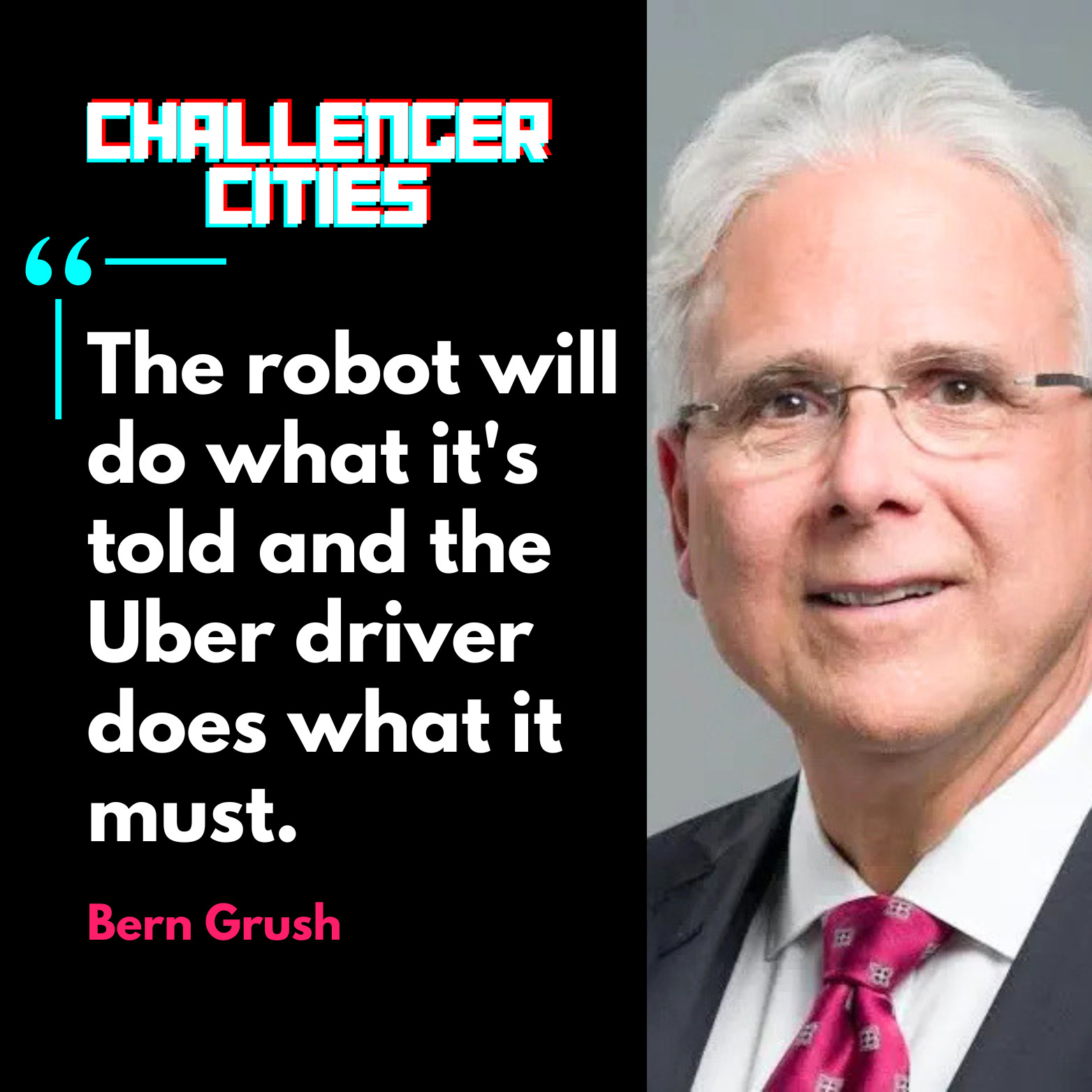
Even better, we don’t have to wait for the robotaxis to prove this out. We could start today, with the ride-hail, taxis and delivery vans already presenting the same problem on the same streets. Bern recognises the difference that “the robot will do what it’s told and the Uber driver does what it must”, and a human behind the wheel is harder to orchestrate than a machine that simply obeys. But that’s a reason to start now, not to wait for the machines and the eighteen million events a year that come with them.
To Being Challengers.


