


You know when you’re in the airport, and you’re looking at the screen saying “wait in lounge”, while the airline app tells you to be at Gate 54 nearly an hour before departure, but FlightAware says it will actually be Gate 62, and it’s anticipating a 20 minute delay leaving?
Maybe you’re thinking you should get to the gate. But maybe you’re wondering if there’s time to get some proper food and still have time to get your bag in the overhead bin.
This sort of thing is pretty common in airports these days, but I’m not sure we realise what it does to our psychology.
Likewise, we see similar issues in stations. London King’s Cross being notorious for announcing a platform about 4 minutes before departure, when the doors close 90 seconds ahead of leaving. So you’ve got the railway warriors on their apps gaming they know which train is theirs, and the people who don’t go down to that there London very often stressing about missing the train their super-off-peak-advance-this-train-only-special-saver ticket is valid for.
At the other end of the station spectrum, you’ve got the unstaffed station with a train every hour, where the automated tannoy blares the “if you see something that doesn’t look right …” message a bit too often to make you feel like that would be an exception … as the peeling “See It, Say It, Sorted” poster sits ominously. Mostly because who would you actually say it to here?
This is probably a bit of a negative way of making my point, but for an industry that exists to move people who might have a choice of how they move, or to not go anywhere at all, the nodes that people get on, off and between things like trains, aeroplanes and buses do seem rather effective at generating an emotional sense of lingering dread.
Often it’s sort of just accepted as something normal … but really it’s a series of design choices … justified for cost reasons. But what if the cost of these decisions is far higher than the surprisingly small cost of designing these places for the people that pass through them?
Now without wishing to hark back to a past, once upon a time, stations and airports were designed and built as civic structures. In some cases as grand cathedrals of engineering prowess, in others a modest structure with a sense of municipal pride. You’ll see that in the grand Victorian termini, the waiting rooms on the branch lines and in the art deco of some surviving early aviation terminals. The buildings were required to show off to tempt people to the new technologies, and show off what they were capable of.
A little later though, as the technologies had caught on and become incredibly successful, the entire brief for a station or an airport was throughput … i.e. move more people through a fixed space in less time. Or in the case of some railways as service dwindled while the car became king, the focus was more on efficiencies to minimise the costs of operating what was seen a bit more like a liability, than an asset.
It was the sensible and logical reaction of the ever more common, managerial class. And seen through a spreadsheet, where you can pretty reliably manage your costs, it sort of worked. The trains that were left mostly ran, and global aviation boomed. The airlines didn’t really have to worry about the airport bit either, and the railways became less fussed about the station experience so long as people go on the train.
Thing is though. That station or airport experience impacts the passenger psychology once they are on the train or the plane. It even influences the thinking of whether that person is more inclined to take the train or the plane. That experience gives us passengers that are happy or grumpy, calm or frustrated, stressed or carefree, anxious or assured.
Rational transport operators often see a passenger’s emotional state as some sort of soft sentiment that can be dealt with at some higher order of marketing or experience fluff. But really, it’s a hard operational fact.
A confident traveller boards quickly, uses the full length of the platform, reads a short delay as a short delay, buys a coffee in the meantime, and comes back. An anxious one bunches by the nearest door, hesitates, asks the same question three times, treats two minutes as a personal betrayal, buys nothing, and makes the internal resolution to drive next time, or just not travel at all.
When Transport Focus ran Britain’s biggest ever rail survey in 2026 with over 100,000 passengers, they found the same delay produces almost opposite passengers depending only on how it’s handled. Handle it well and more than 90% report a positive experience. Handle it badly and that collapses to 25%. The train is exactly as late in both cases, just the only thing that moved was whether anyone bothered to manage how it felt.
Confidence is capacity … and most of our places are leaving heaps of it on the floor.

Now the liberating part, and the reason this isn’t another mournful piece about crumbling infrastructure. The things that shift how a place feels can be almost embarrassingly cheap.
It might be something like decluttering the signage accrued over several ‘transformations’, it can be how a place is lit that influences the mood, sometimes it is a member of staff empowered to help, or a well designed kiosk in a place where staffing is limited. In some cases, airports have reduced the amount of messages being transmitted to a passenger, meaning they don’t hover around the gate, in other cases, it’s making sure there is space for the urgent messages to get through. It can be somewhere for you to put your coffee down while you wait, or prop your laptop to send a document that can’t be accessed so easily on the phone. It might be a familiar brand showing up, or a place to pick up a last minute local item. In a globalised world, a sense of place goes a very long way.
None of this required a grand megaproject, or even an intensive business casing process. Which is rather good news if, like most of the world’s stations, you haven’t got a few spare tens of millions laying around. Or if you’re an airport and that multi-billion dollar terminal has solved a lot of the throughput issues, while still feeling a little hollow.
It’s easy for an industry obsessive about economics and engineering to always be reaching for an expensive answer to what might be the wrong question. That might be the airport spending a fortune instrumenting itself to predict its queue times to the second, then pointing all that cleverness at extracting more retail spend from you, rather than at noticing you’re overwhelmed.
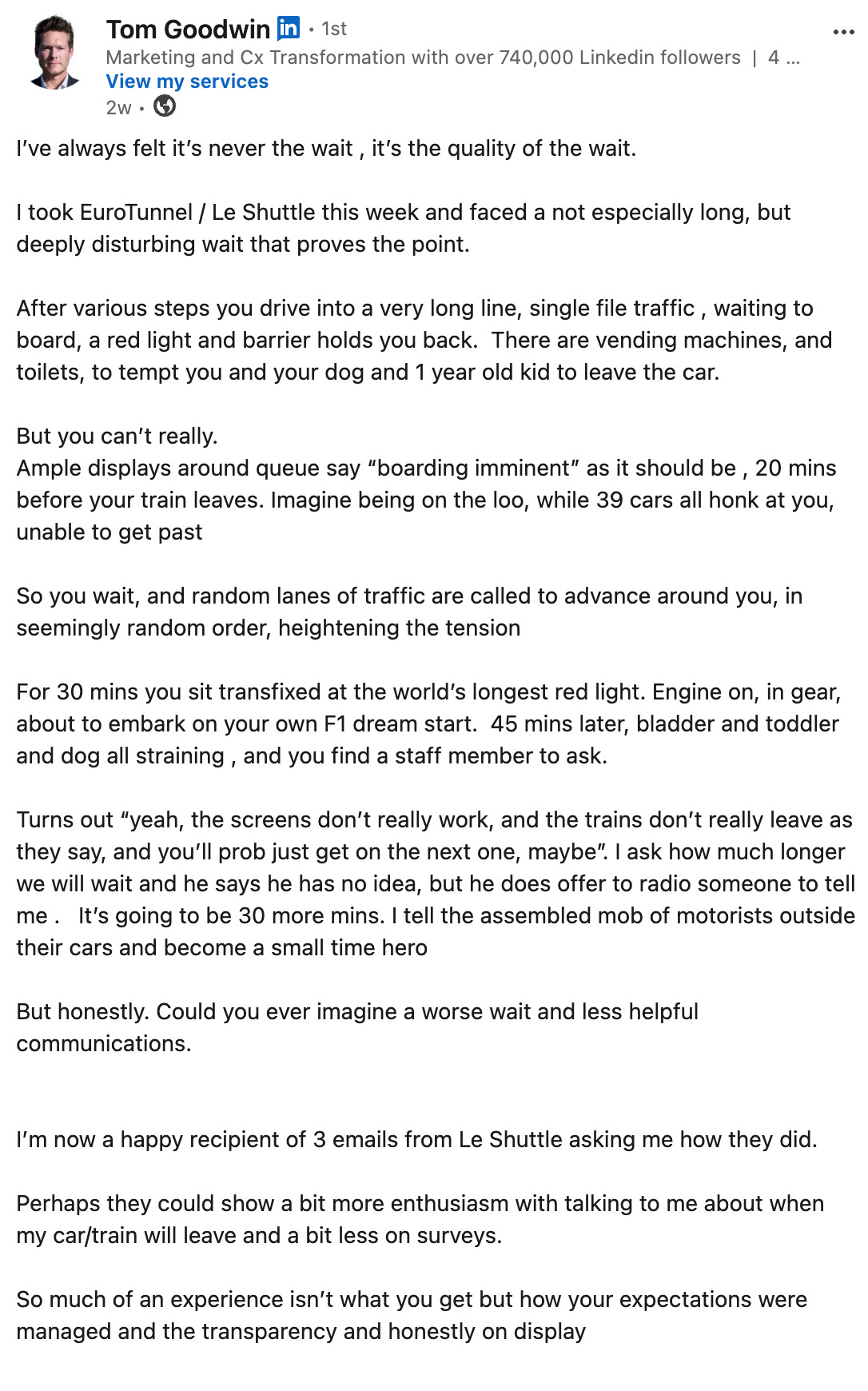
Or it could be Tom Goodwin’s recent experience of a Eurotunnel crossing with half an hour sat in a single-file queue, engine running, in front of screens promising “boarding imminent” that meant nothing, with nobody to ask what’s going on, followed, once he’d finally escaped, by three emails inviting him to rate his experience. Managing the survey but not the experience is sort of corporate culture 101 these days.
The counterintuitive stuff is typically quite cheap to do, try out, see if it works, and then scale when it does. In some ways it’s clever when airports deliberately delay telling you your gate, because certainty too early does make the anxious minority queue unnecessarily early and then sours the wait for everyone behind them. But when this strategy doesn’t match the information being displayed by the airline, it creates greater anxiety.
Rory Sutherland has been saying this sort of thing for years while being treated as a charming eccentric, when he is simply articulating what people might struggle to say themselves.
It’s interesting how in the quest for efficiency, we actually create experiences that can be even more inefficient, just because of how that efficiency is measured.
This isn’t just a call to say “make travel a bit nicer”. For when we design for the ‘average’ passenger … often assuming that person to be calm, sighted, fluent, unhurried, unafraid … the design is for someone who doesn’t actually exist. Three quarters of blind and partially sighted rail passengers say they can’t count on staff being there to help. When the government floated shutting a thousand ticket offices, the public fired back 750,000 responses … the largest consultation response in British history … led loudest by disabled and older passengers, for whom a member of staff is the whole difference between a journey and no journey.
Then there’s safety, both perceived and actual, which under-the-radar kills journeys before they even happen. A woman weighing up the last train from a busy terminus, or a wait on an unstaffed platform in the dark, is running her own personal risk calculation. When the answer comes back with, “hmm, I think I’ll go home early or take an Uber”, her decision doesn’t get registered with the railway. She just doesn’t travel with them, and the network never sees the trip it lost. That, as my old business-case hobby-horse goes, is the entire problem with only ever counting the demand you already have and focusing only on what you can supply.
If there is one lesson from Challenger Cities, it is that we need to spend far more time on designing the places and spaces that people will want, rather than trying to make them fit the places that we can supply.
Rail people and airport people really need to start talking
A few years ago I was commissioned to do a project on ‘Stations of the Future’. I may have mentioned that once or twice. I loved that project and it got me into urbanism really. But then I did the same brief, pointed at ‘Airports of the Future’. The overlap of the people interested in both sectors was almost nil. Even where you saw common engineering and consulting firms, they had their airport people, and their train station people.
I was thinking about this recently as two of my favourite people in this realm are ultimately responsible to two types of transport node that would never, ever, come into the same conversation.
Well, until now.
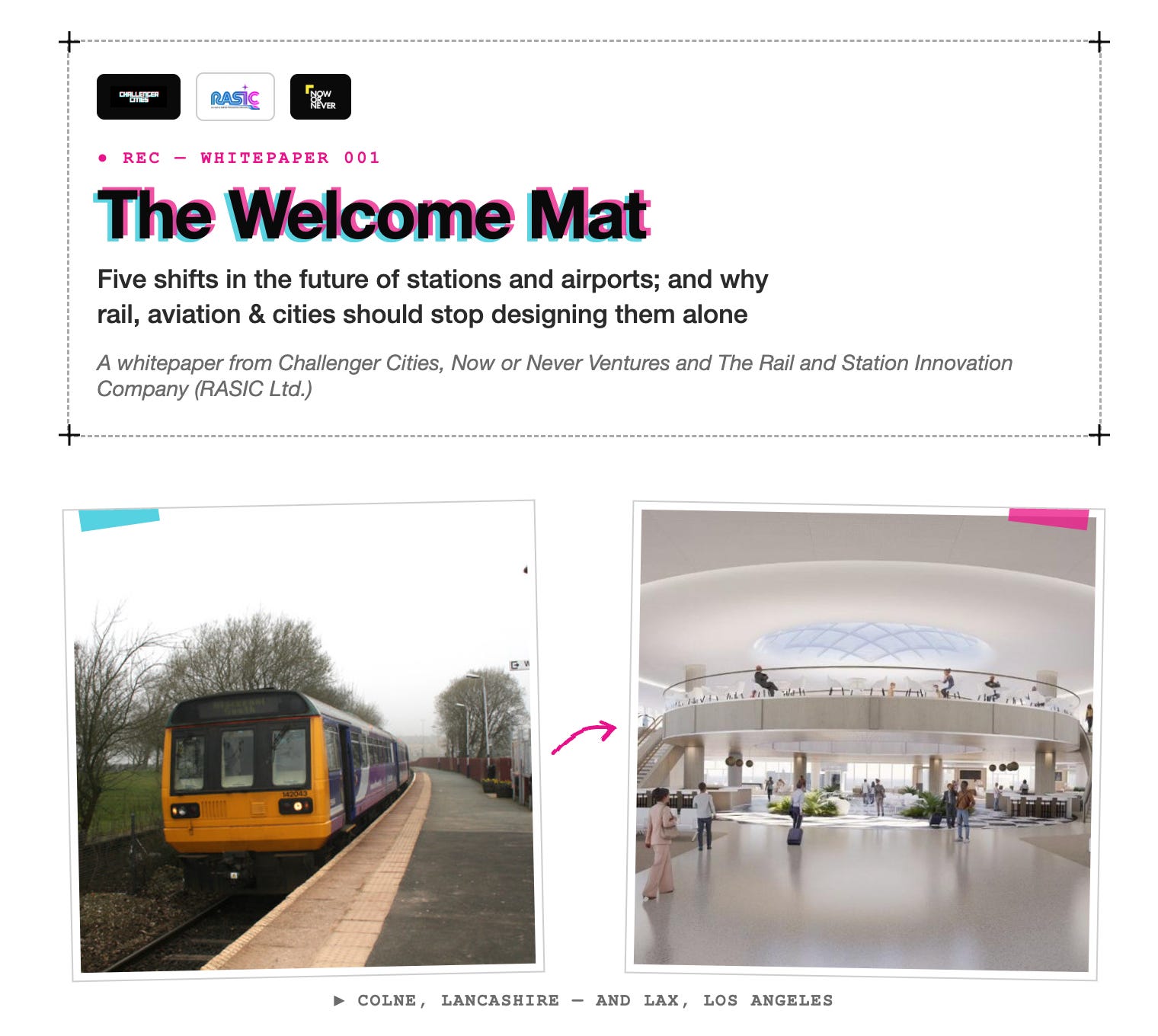
One is a single platform at the end of the East Lancashire line called Colne, while the other is LAX, an international hub with its eight terminals and eighty-odd million people a year passing through. Basically, they could not look less alike. Five and a bit thousand miles separate them. They were built in different centuries, with vastly different budgets. You won’t find many Hollywood celebrities in Colne … for even Dave Fishwick of Bank of Dave fame has a helicopter. But people, with some of the same innate human behaviours and emotions pass through both. They might live different lives, be doing some different things that day, and have different standards of living, but they do read signals overtly and subliminally, paying attention to their surroundings and noticing whether they feel cared for, or at risk of something.
Station people and airport people almost never compare notes. They read different journals, go to different conferences, and treat each other’s hard-won lessons as somebody else’s business entirely. It’s kind of daft. Probably the most useful thing anyone running one of these places could do this year is go and look, properly, at how the other kind does it.
These two people have never met, well not yet, but I reckon Courtney Moore from LAX (coming soon on the podcast, I hope, but part of a previous series I made when she was at DFW) and Alex Hornby from Northern Trains (previously on the podcast) would get on very well, while recognising they are solving very similar challenges. Alex might be a bit envious of Courtney’s budget, and weather, but you never know, Courtney might like a tour of the North of England and its rail system.
The Colne-Los Angeles contrast is also the provocation for setting up a new whitepaper, The Welcome Mat. It drags rail, aviation and cities into the same conversation, combining various hats of Challenger Cities, the Rail and Station Innovation Company (RASIC) and customer proposition design through Now or Never. It lays out five shifts for turning these places from anxiety machines into places people move through with confidence, feel settled enough to stick around, and actually choose to come back to. Grand, era-defining visions for the ones with ambition and a chequebook; as well as trivially cheap interventions for the ones trying to make do with what they’ve got.
Both count.
We’re taking it live on Tuesday 25th August, at 10am Eastern/3pm UK, to be discussed, argued over, and hopefully made better by whoever shows up.
Or you can just have a read of it below.
To being Challengers.
I forget which station in London where there were two completely separate sets of gates and I had no idea where to go because they don't put the gate up until minutes before departure. Or the time I was standing by the track in St. Pancras and suddenly realised that I should be in King's Cross. They do not make it easy.
I smiled at your reference " the automated tannoy" nobody in Canada knows what a Tannoy is. I just happened to own a pair of their speakers once, but it is such a lovely archaic term.
"Managing the survey but not the experience is sort of corporate culture 101 these days. "
Now that is wisdom for the ages. It drives me bonkers when I buy a small widget to get bombarded with "Rate your experience" emails.
I don't mind waiting (things go wrong, that's life) but tell me what is going on - can I go for a pee, a lunch, an extended vacation in Hawaii? Even if you don't know tell us that.
A real world example - flying home from Barbados the plane was massively late, but the staff refused to say where it was (before the days of flightradar24). This would have been massively annoying except we met a guy in the queue to check-in, and he told us 4hrs.
When asked how he knew: "Simple - my wife is flying the plane on the way here, and she texted me when she left because she knew I was getting it back". Apart from feeling smug (we knew something the rest of the passengers didn't) it meant we could do something good because we could plan confidently. Still remember that delay fondly.
I guess the airlines are worried one of their sheep will stray and that will cause them problems, which is the second issue - we are just cargo to them and a prompt departure easily trumps passenger happiness.