

Stop complaining about Toronto. Start doing something about it. A story from the Salon.
A reflection on how this podcast, turned into something more interesting, intimate and potentially, more impactful ... in the back room of a legendary music venue.

As I try to push Challenger Cities in some different directions, so that it’s not just another podcast and a series of opinion pieces on cities, a rather fun experiment has been what may or may not pass as a ‘salon’. The latest of which recently sold out the back room of The Cameron House on Queen Street West in Toronto with 70 people and a $25 dollar cover on a Tuesday night in May.
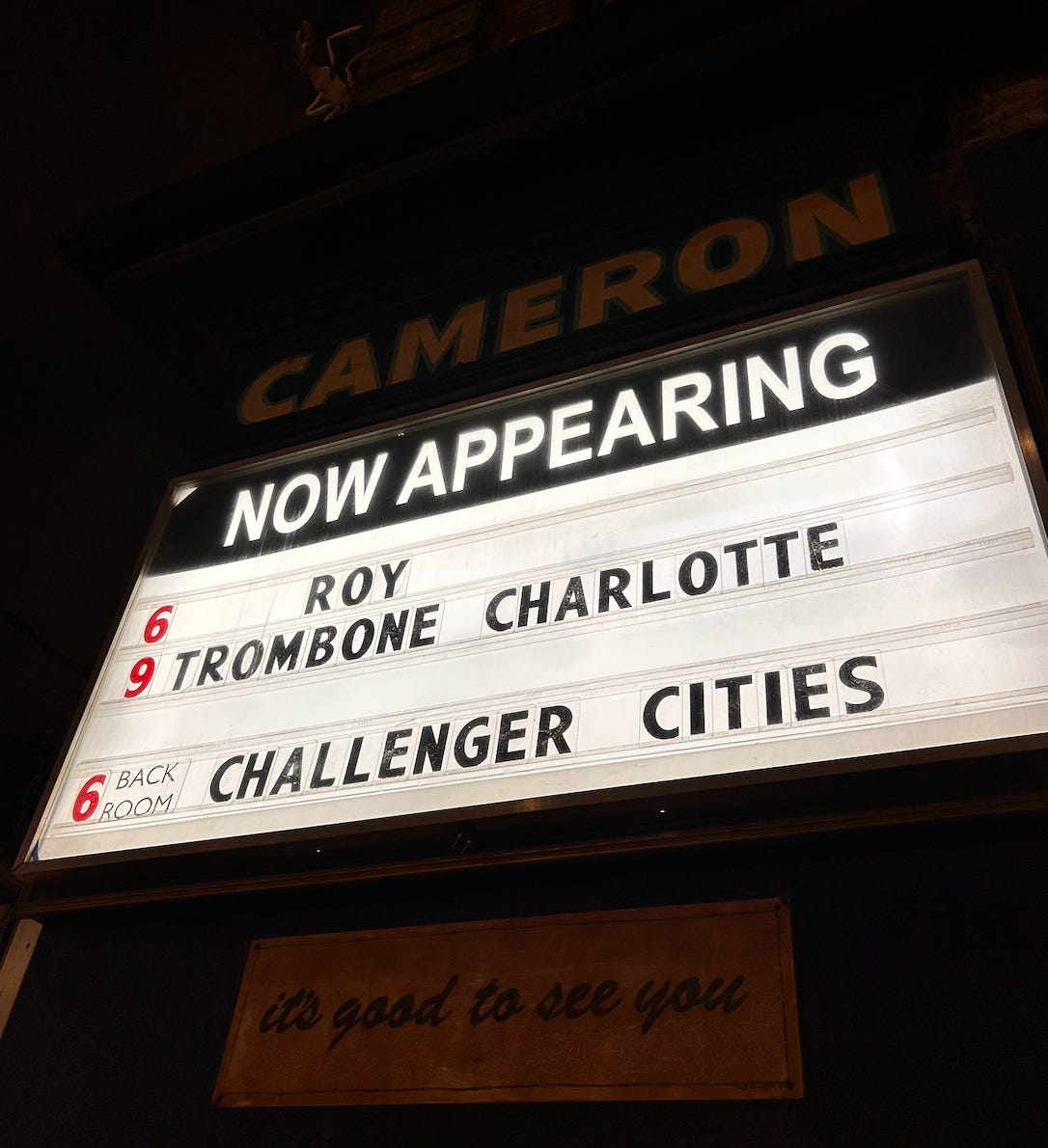
The draw was six Torontonians on a low stage talking about the city with Alex Bozikovic, the Globe & Mail’s architecture critic; Ilana Altman, who runs The Bentway; Jen Angel, who runs Evergreen; travel and urban culture journalist Maryam Siddiqi; Gensler architect Steven Paynter; and Gil Penalosa, who has more fire about Toronto than almost anyone.


Calling it a salon might have been a bit pretentious, and the teenage me growing up in the North of England would have given me hell for it. But it worked. Partly because people want to argue about Toronto and they’ve stopped believing the internet is the place for it.
I don’t even live in Toronto anymore. Montreal is home now, but Challenger Cities, the podcast and now this travelling argument I’ve started staging still has a thread that frequently returns to Toronto. A good chunk of my adult life has been in that city and I’m not sure I’m done with it, even though it frustrates me in the specific way that places frustrate you when they have all the ingredients and somehow play to less than the sum of their parts.
That frustration was in the room the other week, but so was a sense of affection. People don’t pay to attend a back-room evening partially about municipal dysfunction if they’ve given up. They have turned cranky on the internet, sure, but it’s really a form of caring. This meant the conversation ranged across the things you’d expect, including transit, the challenge and cost of building anything, the strange Canadian habit of treating ambition as a personality flaw, in a city that really has lost its mojo.
From the floor, one gentleman made the case that Toronto has no unifying myth, no story it tells itself about itself and that visitors and residents alike pay the price for there being no there, there. Jen Angel argued persuasively that the Canadian fear of risk is itself the biggest risk currently being taken. Steven Paynter, who consults on projects across the United States, described decisions being made elsewhere in months that take years or never get made at all in the city he chose to call home.
We absolutely didn’t agree on everything, the audience didn’t agree with some of it. We contradicted ourselves at times, but it was mercifully polite, because this is still Canada.
One question kept coming back, in different forms, from different people was “who do we actually go to with this?” Not necessarily to just complain, but to propose, perhaps to build something, or to at least get a serious idea taken seriously. Elected officials feel inaccessible, or at best when they do show up, frustratingly timid.
There is a mayoral election this year and I’ll spare you my views on the candidates except to say that the structural problem I am describing predates them and will outlast them. The institutions that should be doing this work are thin, as the civic sector and the private sector spend a lot of energy blaming each other for things neither of them is positioned to solve alone.
So what fills the gap? On Tuesday night, the gap was filled by a person from out of town with a Substack and a music venue better known for indie, folk or country music than for civic discourse.
That should embarrass somebody. It doesn’t embarrass me - I had a great time - but it should tell you something about what isn’t happening in the places it ought to be happening.
I started Challenger Cities two years ago because moaning was making me miserable and making nothing better. It was the smallest possible thing I could do that felt like the opposite of moaning. The way I think change actually happens is you imagine the biggest possible future you can get excited by, and then you do the smallest possible thing right now that points toward it.
In Montreal, where I live now, there's a rather cute municipal program where you can adopt the plot of soil around a street tree. That’s my smallest possible thing there, but in Toronto, today, my smallest possible thing is this. It was originally meant to be an op-ed in the Globe & Mail, or the Toronto Star, but they said no … hey-ho … so here it is.
There is no shortage of writing about what’s wrong with Toronto. Heck, I’ve done enough of it. Most of it is engineered to be shared by people who already agree, which is to say it is a complaint dressed up as analysis.
Steven Paynter made a point on the night that deserves more attention than it’s getting. The pandemic, for all its damage, made a lot of our neighbourhoods better. People rediscovered the streets they lived on so the places near home became the places they actually used. Toronto trades on being a city of neighbourhoods, a cliché (for that is kind of what a city is, and Toronto might not be that special at it imo), but the gains during those years are real. Now, Toronto has a downtown that hasn’t recovered its purpose, with offices that don’t fit the way people now work and a transit experience that punishes the people grinding back into it.
The instinct now has been to drag everyone back, fill the towers, restore the old pattern and prop up the legacy economic model. That instinct will undo the neighbourhood gains without fixing what is broken in the core, and it will do real damage to the city and the economy underneath it. This is not a problem a mayor solves. It needs companies and executives that care about more than their lease, banks that recognise they are civic actors whether they like it or not, and the professionals across this city to stop running pilots when they should just be doing the thing.
The temptation, in an election year, is to pin all of this on whoever holds the chair at City Hall. Change the name, change the face and feel better for about six weeks. But if the only thing that changes is the politicians, the only thing that changes is who we complain about.
So we all need to do our bit. With our ideas, on our streets, in our buildings, with our colleagues and neighbours, on our little slices of social media as well as in back rooms of bars. We’ll fix this by behaving like challengers, in public, in small ways, and not just on Tuesdays.
(because the next one of these is on a Monday, in Montreal, on June 8th … tickets here)
To being Challengers.

The take about downtown Toronto is very interesting. It's the same thing in Montréal where you also have lobbys asking for the return to office without asking question on why nobody wants to work a full week in Montréal's downtown...