



Greg Lindsay is back for a second go, which means he has to top his last appearance on this podcast, and he’s brought Bryan Boyer with him. The pair of them found each other because there are only two urban technology programmes of note in North America, Bryan’s at Michigan and Anthony Townsend’s at Cornell Tech, and Greg has spent a few years triangulating between them as what he calls an accidental urban futurist.

Bryan’s unconventional route in is the sort I always find interesting. He dropped out of college to work in tech, started a company, and then at some point said, right, ‘I’m going back to school to study architecture’. He’s been bouncing between the two ever since, including a spell at Sitra, the Finnish innovation fund, on a project called Brickstarter that we’ll come back to. Now he’s faculty director of the University of Michigan Center for Innovation in Detroit, with 200,000 sqft going up in the middle of downtown, and founding faculty director of its new Masters of Urban Technology.
What ties it together is a question he says has nagged at him his entire career, which is “why is this stuff so hard and why doesn’t it work better?” Which is also, more or less, half the questions I get from people interested in Challenger Cities. The answer, or at least the diagnosis, is a paper he and Greg have written called Chain Drain.

Bryan opened with a small example. If he wants to make a word bold in a document he can hit a keyboard shortcut, use the menu, or now just say it out loud with voice technology. He’s got three equal and available options. But when he designs a window in a particular place, and the structural engineer says there needs to be a column there, and the person doing the MEP (Mechanical, Electrical, and Plumbing) says there needs to be a drain there, then “one of us is going to win, and the others are going to adapt.”
On a good day nobody will be able to tell, and that invisible resolution is more or less the magic of design. On a normal day you get the built environment most of us actually live in, which Bryan describes with a candour I appreciate:
“Windows in shitty places, doors that don’t make sense, spaces that are not fit for purpose, buildings that are built to be operationally carbon efficient, but filled with embodied energy or embodied carbon that is hugely negative.”
So the question isn’t really why building is hard. It’s why it’s so hard for our decisions to land the way we’d like them to, which gives you the thesis in short:
“Changing the way that we make decisions is the core of changing the outcomes or the outputs of the work that we do.”
Chain Drain is defined as the state of discoordination and disconnection across the activity of delivering the built environment. We should address those two words.
Discoordination is the mismatch at the handoffs. Say somebody wants a building. A team will assemble to assess the feasibility, then it will go to design, then engineering, construction and commissioning, before leasing and operations. Which works so long as everybody has done it before, and nobody has, because “every single project effectively is a prototype” … something always changes, the client, team, jurisdiction, regulatory context, economic/political/environmental climate we’re now designing against.
So when the architect hands the structural grid to the engineer, “it’s almost as if they take two steps back before they take a few steps forward.” Sometimes that’s a genuine reframing of the brief and the building gets better for it. But, often it’s just repeated effort, sometimes the dumbest possible version:
“I gave the engineers a file in a format that they don’t work with, or that was missing information. We had to go dig through folders to get it. This is just like an absolute waste of time.”
Disconnection is the more damaging of the two, and it’s about the repetition or frequency of the feedback loops. You might be getting a connection to EP100 at this point. Bryan’s comparison is a restaurant, which puts a dish out many times a night and gets three separate signals back: people say it was great or terrible, the kitchen sees what came back on the plate and the accounting software says whether it worked.
An architect gets none of that. “If it’s public, I can go observe. If it’s private, I have to negotiate a special right even to go into that space and see how it’s performing. I generally don’t have any access to the sales data, to the environmental performance, to any of these things unless there’s a failure.” And in that case, “somebody comes back to me and they’re pissed. So that conversation is already positioned in a certain way and it’s not in my favour as a designer.”
Greg’s example is 270 Park Avenue, JPMorgan Chase’s new headquarters, a $4bn building that replaced a perfectly good skyscraper and into which Jamie Dimon has ordered his bankers five days a week. “They do not, in fact, know how those people even use that space.” The data is siloed between real estate or facilities, IT and HR, and even assembled there’s no route back to the people who designed the building in the first place.
Every trick we use to get better in manufacturing, software or even hospitality needs a loop that captures information, feeds it back and allows the lessons learned to be applied. But we, learn almost nothing from our buildings.
Technology has been trying. Bryan built a database of roughly 11,000 startups across proptech, contech and AEC (Architecture, Engineering & Construction) tech, absorbing something like $160 billion, with strikingly little to show for it. Greg’s favourite artefact of the incumbent side is Revit, invented in 1997, bought by Autodesk in 2002, and now so locked in that Andreessen Horowitz could publish an essay pointing out that every building you have ever set foot in was designed by software made in 1997. We’re effectively building cities in Winamp. Meanwhile general contractors distrust PDFs and want printed drawings, because a digital file might hide or omit something, while paper is considered as complete. The analogue is held in place by liability as much as nostalgia.
The most expensive attempt to fix it was Katerra, which set fire to $2 billion of Masayoshi Son’s money trying to pull the entire industry onto a single balance sheet, so every pivot dragged the whole thing with it. At the other end of the scale, Boon Sheridan surveyed four hundred automated permitting tools and gave the write-up the best title in the sector: A Tool for Everything, a Solution for Nothing, because none of them connect to the rest of the chain.
Which brings us to the scenarios in the paper. They sit on a two-by-two, running vertically from using digital tools up to genuinely embracing digital transformation, and horizontally from low supply chain innovation, roughly the year 2000, out to radical reconfiguration of who does what. They have named the four quadrants after the buttons on a VCR.
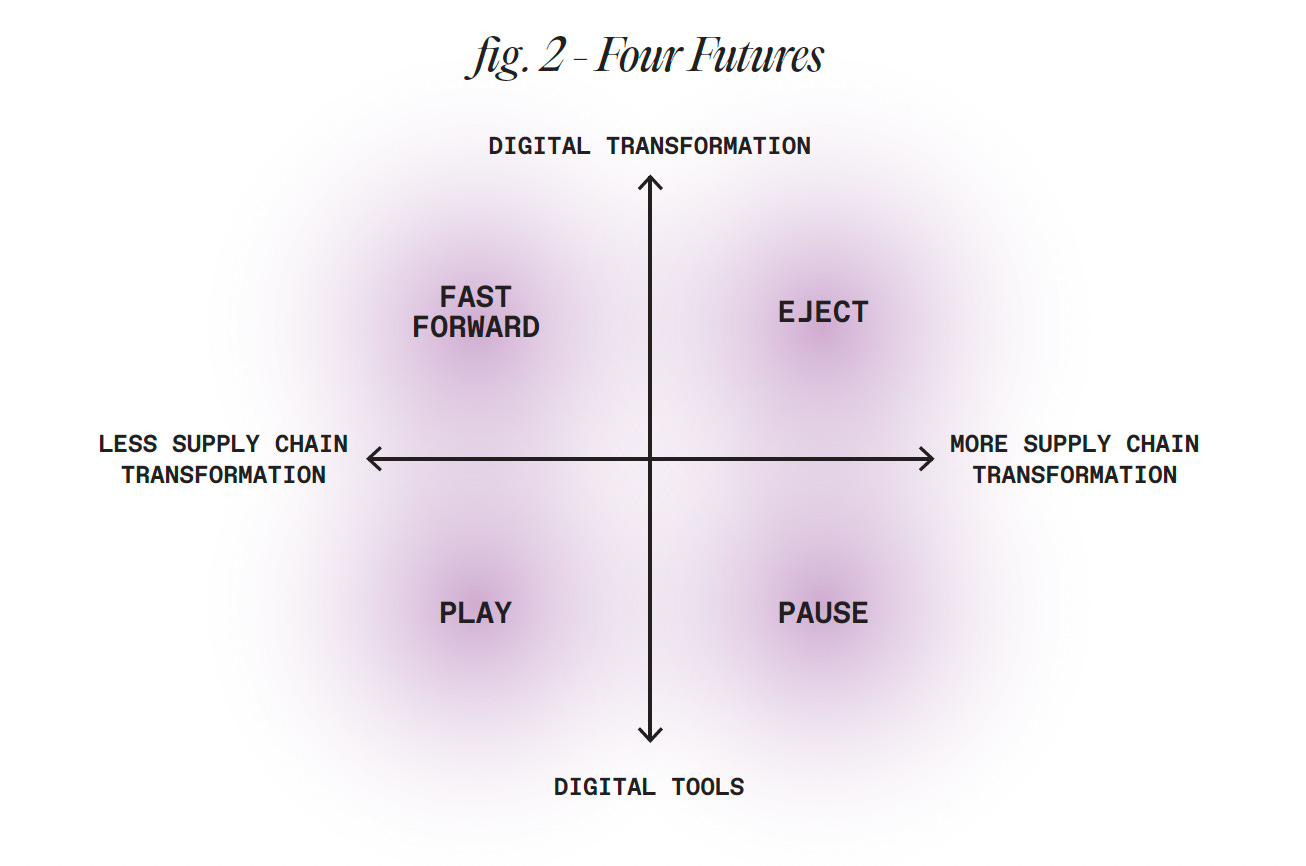
Play is now. AutoCAD, Revit, a bit of Grasshopper to lay out the car park. Existing chain, everyone slightly faster. The corporate version is AECOM buying an AI company for $390 million, after which clients started abandoning the platform precisely because AECOM now owned it.
Fast Forward keeps the chain but automates the joins, so the answer comes back from an agentic workflow rather than a human driving a product, and it presumes a super-empowered client who can force accountability along the whole thing. Greg’s exhibit is KP Reddy, whose new venture Zero RFI is explicitly not B2B SaaS. They’re buying owners’ reps, to sit at the client’s right hand and do the transformation on their behalf.
Eject is productisation and vertical integration. Stop selling a chain of services, start issuing a product, get a direct relationship with whoever uses it. The dream is old, going back to Corbusier, and every serious attempt has been ruinous. But the logic underneath is hard to dismiss:
“How long will society wait for the professionals in the AECO sector to figure out how to work together more expediently? … At some point it will break and somebody will say, your supply chain is the problem. We’re gonna go a different way.”
Pause is the one I found most interesting, and the one Claude got genuinely stroppy about when I fed it the paper the day before we recorded. Unrealistic, it said. A fourth box, filled in to complete a two-by-two. Greg’s response was that Claude is simply wrong. Bryan’s was more enjoyable: “as a giant statistics machine, AI is really good at telling us what we already know in different permutations.” Eject is a familiar dream, which is why it reads as plausible. Pause is new, and therefore illegible to it.
Pause is, roughly, first do not build. Kelly Alvarez Doran’s framing that we don’t have a housing problem, we have a square footage problem, with an enormous existing building stock allocated the wrong way. The Mortgage Bankers Association arguing the US could be in a housing glut by 2045 on demographics alone. European circularity regulation, and tariff regimes are doing the same work from entirely different motives. And unlike Eject it scales from the bottom, through deconstruction outfits stripping buildings and reselling the materials rather than landfilling an entire fit-out every time a tenant changes over.
It also swaps the developer for the rest of us. More Baugruppen, where a group get together and build the apartment building they want to live in, rather than someone in the middle guessing on their behalf. “So much of that few steps forward, few steps back rhythm comes from people guessing at what everybody else wants.” Remove the guesses and you get a tighter chain.
So perhaps the binding constrain is less about technology, and more about the clients. Alexandra Donovan at Assembly OSM gets told: “this is cool, but we don’t want to be your first or your second or your fifth, or maybe not even your tenth. Can you come back when you’ve done twenty-five of these?” Katerra may have died of manufacturing economics, or because there was no market for the innovation at all. Every scenario is really a different answer to what kind of client turns up. Fast Forward empowers them, Eject transforms them and Pause replaces them.
I think there’s a bit of an analogy here from my corporate innovation background, as 15 years ago one of the biggest clients for the consultancy I worked at was British Gas, then the UK’s number one energy supplier. They were spending a fortune with consultants because they knew they had to do digital transformation, but what they actually did was a series of individual projects. So there would be ERP or CRM implementations, often multiple of them happening in different business units. We’d be doing a proposition design project here and there, while another firm would come in to do the build and integration of something.
In a way, it’s a bit like the analogy Tom Goodwin lays out in Digital Darwinism, of electric lighting installed in a factory still laid out in the same model as steam was using. The number one supplier in the UK today is Octopus, which didn’t exist when I was doing that work circa 2013/14. It’s a live example of Play losing to Fast Forward. Meanwhile households with solar, a home battery or an EV, who don’t need the grid eighty per cent of the time, are living examples of Eject from the demand side of the coin.
Greg has another good analogy. “AI is a microwave. It doesn’t transform you, it just makes what you’re doing faster, it accelerates the molecules.” He asked an architect how the practice was using it and got the response that instead of giving the client three options, we’re giving them five or fifteen. Wonderful. Maybe? But what about the strategic conversation about whether people need all that, or if that just creates more work, hesitation or reduced confidence?
Greg and I keep banging on about the demand side of urbanism, because essentially all urbanism is supply side. Bryan’s chimed in here with “That’s why we created Brickstarter.”
The context was Kickstarter urbanism around 2011. +Pool, the floating pool for the East River, raised tens of thousands against a budget in the tens of millions and is only now about to be built. A crowdfunded RoboCop statue for downtown Detroit went up last year. These are real signals that people want a hand in the built environment but struggle to play a role. So Brickstarter asked how you feed that appetite back into the supply side dynamics that already exist. Let people say I wish this thing on my block were a hair salon, or a daycare, and over time you aggregate demand signals that are currently very hard and expensive for anyone to assemble.
Home Depot has a GIS team on demographics and a marketing team on purchase behaviour to triangulate between. Someone leaving their job as a lawyer to open a single restaurant has no way of finding any of that out.
The other half came out of Finnish wind farms, and it’s the line of the episode:
“The government has an inbox for no, but the government doesn’t have an inbox for yes.”
We’ve built a functioning, well-understood, always-open channel for the objection of the relative and essentially nothing for support for what can often be the silent majority. So no city can see the balance between the two, and no government can adjudicate honestly between the people who actually want a thing and the people who don’t like the idea of a thing.
Some of that is on us, because we do the front end so badly, rarely articulating the customer proposition of something up front, or at the beginning of the chain. What we get is a glossy render nobody believes will be real, or too vague to actually picture, followed by an enormous effort at the back end to make people want the thing. To borrow John Wilshire, don’t make people want things, make things people want. Somebody has to be given something they’d wave a flag for.

Greg adds that under this degree of financialisation, almost nobody is making products for people, they’re making products for markets, and their own interviews with owners bore it out … we don’t ultimately care what’s happening inside the supply chain, as long as it produces financialisable assets that fit our models.
Greg’s smallest possible thing is a job that has essentially existed once. Early coworking created the first role whose function was to watch how people used a space. It never evolved, and it’s precisely what’s missing. He wants every organisation, every community, arguably every city to have somebody whose job is simply to observe how space gets used, and a route for what they see to travel back up the chain. Frank Duffy invented post-occupancy evaluation and wrote that we were mindlessly producing office buildings, eleven years before the pandemic proved him right.
Bryan’s is disconnection from both ends. Connect people back to the process that produces the city around them, and give the people doing the work real intelligence they can use on a weekday morning. He’s clear that no amount of cleverness substitutes for it … “there’s certainly no amount of genius on behalf of one person or any one team that can perform better than reconfiguring the way that people participate.” And he was blunt about who’s carrying the current system:
“There’s too many people that I know who do great work that’s at a small scale, that’s underpaid, that’s under great stress … basically making lots and lots of sacrifices to be able to participate in making great quality cities. And too often that work is all expended to create essentially luxury spaces.”
Fix how the work works, and you improve life for the people doing it and for the people who end up living in the result.
The reason to read the paper isn’t really the scenarios, though. It’s that chain drain is a lens you can’t put down. Greg and I were both at FWD50 in the summer, where Hilary Hartley, formerly Ontario’s Chief Digital Officer, gave a talk on why government digital transformation could never succeed. She was, without ever using the phrase, describing Chain Drain exactly, and Greg spent the session sending Bryan screenshots of it.
“I feel like I’ve been red pilled,” he’d been telling Bryan the whole time they were writing it. “I see it everywhere.”
I’ve now got the same problem. It came up in another conversation this morning. It’s the actual reason so much of what we build could be much more lovable, commercial and scalable. It’s not any single act of incompetence or villainy, just a very long chain where nobody owns the joins and little feedback reverberates.
To being Challengers.


